Types of Fire and Safety Institutes in India: Which One Fits You (2026)
"Which is the best fire and safety institute in India?" is one of the most common questions students ask. The honest answer: there is no single best institute, because India has five different types of fire and safety institutes, and each one leads to a different career. The right choice depends on your marks, your stream, your budget of time, and the job you want at the end.
Short answer: match the institute type to your goal
- Want to join a government fire service as an officer, and have 12th with PCM? A government fire engineering college such as the National Fire Service College, Nagpur (admission through JEE Main).
- Already an engineer with plant experience, aiming for a statutory Safety Officer post in a factory? The one-year industrial safety diplomas run by the Labour Ministry's DGFASLI institutes, or the route your state's Factories Rules name.
- Want a 4-year engineering degree in safety? A university engineering department such as CUSAT, Kochi.
- Finished 10th, 12th or ITI in any stream and want to start working in safety within a year? A skill-training institute with recognised diplomas, such as NIFS, or a state technical board diploma.
The 5 Types of Fire and Safety Institutes in India
1. Government fire service colleges
The best-known example is the National Fire Service College (NFSC), Nagpur, which works under the Ministry of Home Affairs. It offers a 4-year B.Tech in Fire Engineering, affiliated to RTM Nagpur University, with an intake of about 60 students a year. Admission is through JEE Main, and 12th with Physics and Mathematics is required, followed by physical fitness and medical tests.
Suits you if: you have science (PCM) marks, can clear an engineering entrance, and want a career in municipal or state fire services or as a fire engineer.
2. Government labour institutes (DGFASLI)
The Directorate General of Factory Advice Service & Labour Institutes (DGFASLI), under the Ministry of Labour, runs a one-year, full-time industrial safety diploma at the Central Labour Institute, Mumbai and the Regional Labour Institutes at Chennai, Faridabad, Kanpur and Kolkata. The same course carries different names: ADIS at Mumbai, PDIS at Kanpur, Kolkata and Faridabad, and DIS at Chennai.
DGFASLI describes these courses as the recognised statutory qualification for appointment as a Safety Officer under the Factories Act, 1948. Seats are limited and eligibility is set in DGFASLI's yearly prospectus, so check it directly before applying.
Suits you if: you already have an engineering degree or diploma plus industry experience and want a statutory Safety Officer post in a factory.
3. University engineering departments
A few universities run full engineering degrees in safety. CUSAT (Cochin University of Science and Technology) started a B.Tech in Safety & Fire Engineering in 1996, one of the first in India, with an intake of about 60. Admission is through the Kerala engineering entrance (KEAM).
Suits you if: you want a 4-year engineering degree and are ready for a competitive entrance exam.
4. State technical board diplomas
State Boards of Technical Education, such as SBTET in Andhra Pradesh and MSBTE in Maharashtra, approve safety diplomas that are taught at polytechnics and approved training institutes. Recognition comes from the state board, so the certificate is only as strong as the board named on it. Always check the board's name on the final certificate, not just the institute's brochure.
Suits you if: you want a state-recognised diploma in your own state.
5. Skill-training institutes with university and NSDC links
This is the largest group, and the one most students actually choose. These institutes run short certificates, one-year diplomas and, in some cases, degrees through a partner university. Entry is usually open to 10th, 12th, ITI or diploma holders from any stream, and training is built around practical skills for industry jobs. Quality varies widely in this group, so this is where checking matters most.
Suits you if: you want to start a safety career quickly, without an engineering entrance exam.
Side-by-Side Comparison
| Institute type | Example | Typical course | Entry route | Leads to |
|---|---|---|---|---|
| Government fire service college | NFSC Nagpur (Ministry of Home Affairs) | B.Tech Fire Engineering, 4 years | 12th PCM + JEE Main | Fire services, fire engineering |
| Government labour institute | CLI Mumbai; RLIs Chennai, Faridabad, Kanpur, Kolkata (DGFASLI) | ADIS / PDIS / DIS, 1 year full-time | As per DGFASLI prospectus | Statutory Safety Officer in factories |
| University engineering department | CUSAT, Kochi | B.Tech Safety & Fire Engineering, 4 years | 12th + state entrance (KEAM) | Safety engineering roles |
| State technical board diploma | SBTET (AP), MSBTE (Maharashtra) approved courses | Safety diplomas, about 1 year | As per board rules | State-recognised safety roles |
| Skill-training institute | NIFS India and others | Certificates, 1-year diplomas, B.Sc via partner university | 10th / 12th / ITI / diploma, any stream | Safety supervisor, safety officer and HSE jobs in industry |
Which Type Fits You? Four Common Profiles
- 12th with PCM and a good JEE or state entrance rank: look at government fire engineering colleges and university B.Tech programs first.
- 12th in any stream, or ITI: an entrance-free route makes more sense. A one-year diploma gets you job-ready fastest, and a B.Sc gives you a full degree. Our guide to safety officer courses after 12th explains the options.
- Working engineer who wants a factory Safety Officer post: check your state's Factories Rules for the exact qualification required, then choose the course that matches it. Our guide on how to become a safety officer in India covers this route.
- Graduate looking for an HSE job in India or abroad: a one-year PG diploma or advanced diploma from a recognised institute, combined with site experience, is the common path.

Where NIFS India Fits
NIFS India is a type 5 institute: a skill-training institute with recognised programs. Here is what can be checked independently:
- University degree: the B.Sc in Fire & Industrial Safety (3 years) is awarded in collaboration with Acharya Nagarjuna University, a UGC-recognised state university.
- NSDC diplomas: programs such as the Diploma in Fire & Safety (1 year, 10+2 / ITI / any stream) run under the NSDC framework.
- State board program: the Industrial Safety Engineer (SBTET) course, for engineering degree or diploma holders with 3 years' experience.
- Quality certification: ISO 9001:2015.
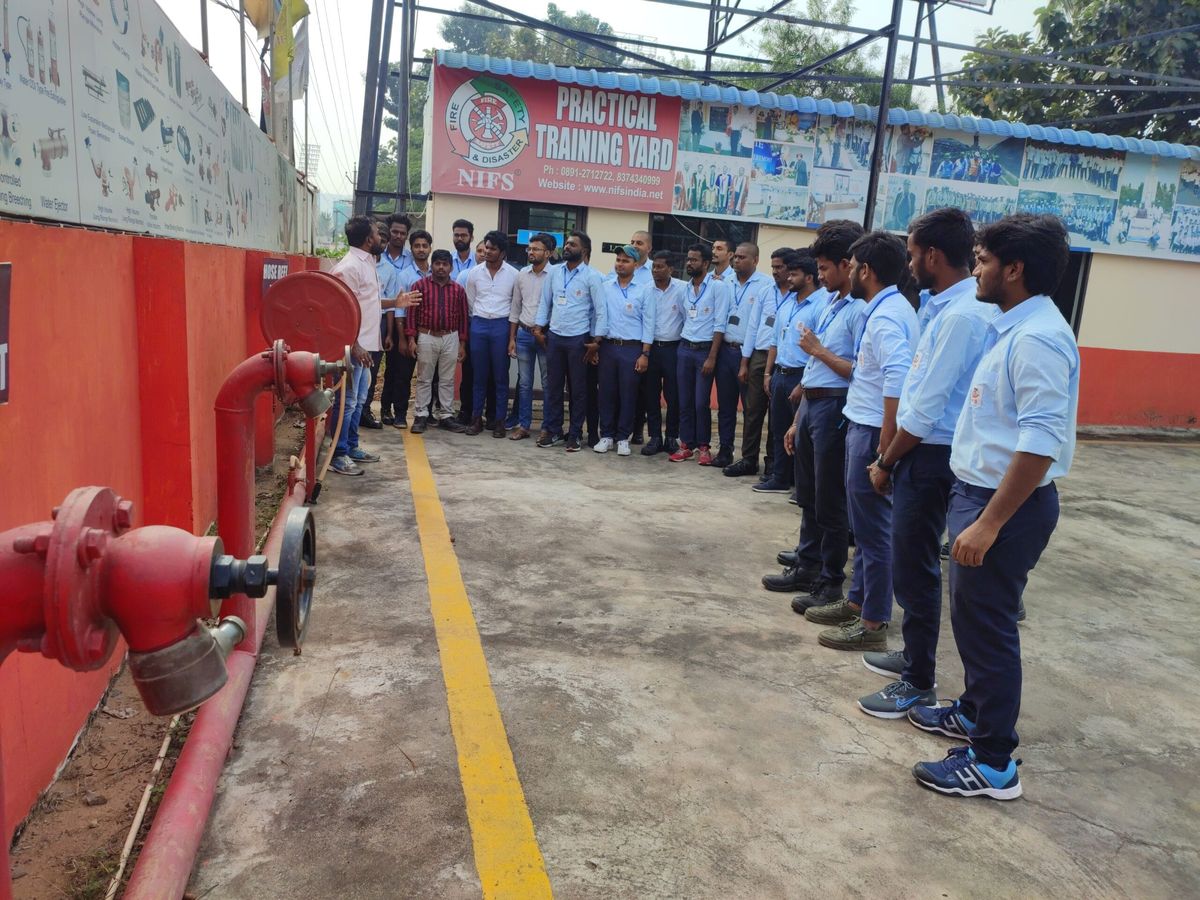
- Practical training: a dedicated practical training yard in Visakhapatnam for hydrant, hose and emergency drills.
- Placements you can check: the placements page lists named students with their employers, including NCC Limited, Pennar Industries and Amazon.
- Real addresses: every centre is listed with its address on the centres page.
What NIFS is not: it is not a government fire service college, and it does not offer NEBOSH, IOSH or OSHA certifications. If your goal is a JEE-based fire engineering degree, types 1 or 3 are the right fit.
Before You Pay Any Institute
Whichever type you pick, check the institute before paying a fee. Two of our guides cover this in detail:
- How to verify a fire safety institute is real: 7 checks covering affiliation, facilities, faculty, placements and fees.
- Government-recognised degree vs private certificate: why the name on your final certificate matters.
If you are choosing between a diploma and a degree, read ADIS vs B.Sc Fire & Industrial Safety.
Not sure which route fits you?
Share your qualification and career goal with an NIFS counsellor on WhatsApp. If another type of institute suits you better, they will tell you.
Companies Currently Hiring Through NIFS
KPC PROJECTS LTD
3 positions open
PON PURE CHEMICAL INDIA PRIVATE LIMITED
Safety Trainee
Frequently Asked Questions
Which is the best fire and safety institute in India?
There is no single best institute. India has five types: government fire service colleges (such as NFSC Nagpur), DGFASLI labour institutes (CLI Mumbai and the RLIs), university engineering departments (such as CUSAT), state technical board diplomas, and skill-training institutes. The right one depends on your qualification and the job you want.
Which fire and safety institute is right after 12th?
With 12th PCM and an engineering entrance rank, look at B.Tech fire or safety engineering programs. With 12th in any stream or ITI, a one-year recognised diploma or a B.Sc in Fire & Industrial Safety lets you start without an entrance exam.
How do I get admission to National Fire Service College, Nagpur?
NFSC Nagpur admits students to its 4-year B.Tech in Fire Engineering through JEE Main, followed by counselling by RTM Nagpur University and physical fitness and medical tests. 12th with Physics and Mathematics is required.
Which course makes me a statutory Safety Officer under the Factories Act?
The qualification is set by each state's Factories Rules. DGFASLI describes its one-year diplomas at CLI Mumbai and the Regional Labour Institutes as the recognised statutory qualification. Check your state's rules before choosing a course.
Is NIFS India government recognised?
NIFS is a skill-training institute, not a government college. Its B.Sc in Fire & Industrial Safety is awarded with Acharya Nagarjuna University (UGC-recognised), its diplomas run under the NSDC framework, it runs an SBTET program, and it is ISO 9001:2015 certified.
Start Your Career in Industrial Safety Today
NSDC-approved Diploma, Advanced Diploma, and Degree programs with 100% placement assistance at top companies like L&T, Adani, and Reliance.