How to Choose a Fire and Safety Institute in India (2026 Checklist)
By NIFS India | Updated 9 November 2026
Quick answer: To choose a fire and safety institute in India, check five things before you pay: who issues the certificate (a university or a government-approved body), whether you get real practical training, the course length and entry rules, a clear written fee, and placement claims you can check yourself. Then visit the centre and compare.
Who wrote this guide? This guide is published by NIFS India. We are a fire and safety institute ourselves, so this page gives you a checklist, not a ranking of other institutes. Use it to check any institute, including us.
Many students search for a "fire and safety institute" or a "safety institute in India" and find lists that are hard to check. A checklist works better, because you can test every claim yourself on official websites. This guide uses only facts we could check on official sites and on the NIFS course pages (read 9 November 2026).
What should you check before joining a fire and safety institute?
Check five things: the body that issues your certificate, the practical training, the course length and eligibility, the full fee in writing, and proof behind any placement claim. If an institute cannot show these clearly, take your time. A good fire safety institute will answer each question in writing and let you visit the centre first.
Use this table as your checklist. Print it or keep it on your phone when you visit.
| What to check | How to verify | Red flag |
|---|---|---|
| Who issues the certificate | Ask for the name of the university or approval body. Search for it on its official website. | The institute will not name the certifying body, or the name is not on any official site. |
| University recognition | Look up the university in the lists under the Universities menu on the UGC website. | The university appears in UGC's fake universities list, or you cannot find it anywhere. |
| Skill approval (NSDC) | Check the official NSDC website and the Skill India Digital Hub. | Only a logo on a poster, with no proof you can check. |
| Engineering or technical approval | For B.Tech or B.E. courses, use "Verify Institute Approval" on the AICTE website. | A short course is sold as an "engineering degree". |
| Practical training | Visit the centre. Ask to see the equipment and the practical timetable. | Only videos or slides, no hands-on sessions. |
| Course length and eligibility | Compare with the course page and the prospectus. | Very short course with a big title, or no entry rules at all. |
| Fees | Get the full fee, exam fee and certificate fee in writing. | Pressure to pay today, or new charges after you join. |
| Placement claims | Ask for job openings you can check and talk to former students yourself. | Promises of a sure job, with no proof. |
Is the institute recognised by a university or the government?
Ask one simple question: "Whose name will be on my certificate?" A training centre may teach the course, but the certificate should come from a university or a government-approved body that you can find on an official website. If the only name on the certificate is the centre itself, ask what that certificate is accepted for.
Recognition comes in different types, so match the type to your goal:
- University certificate or degree: issued by a university. Check the university on the UGC website.
- Skill training approval: linked to the National Skill Development Corporation (NSDC) and the Skill India system.
- Engineering degree (B.Tech or B.E.): the college should be approved by AICTE.
Many students search for a "fire and safety course government colleges list" or a "diploma in industrial safety from a govt recognized institute". The fastest way to check is to go to the official lists yourself, not to trust a list on a private website, including this one.
How can you verify approval claims like NSDC, UGC and AICTE?
Do not trust a logo on a poster. Ask the institute for the exact name of the approving body and the course, then check it on that body's official website. It takes about ten minutes and can save you a year. If the name does not match or cannot be found, ask the institute to explain in writing.

Follow these steps:
- Ask for names in writing: the certifying university or body, the exact course name and the duration.
- Check the university: open the UGC website, go to the Universities menu and look in the right list (for example, State Universities). Also check the Fake Universities list.
- Visit the university's own website: for example, the official site of Acharya Nagarjuna University.
- Check skill approval: look at the NSDC website and the Skill India Digital Hub.
- For engineering degrees: use the "Verify Institute Approval" link on the AICTE website.
- Ask to see a sample certificate: check that the names on it match what you found online.
For more on this, read our guide on how to verify a fire safety institute is real.
Does the institute give real practical training?
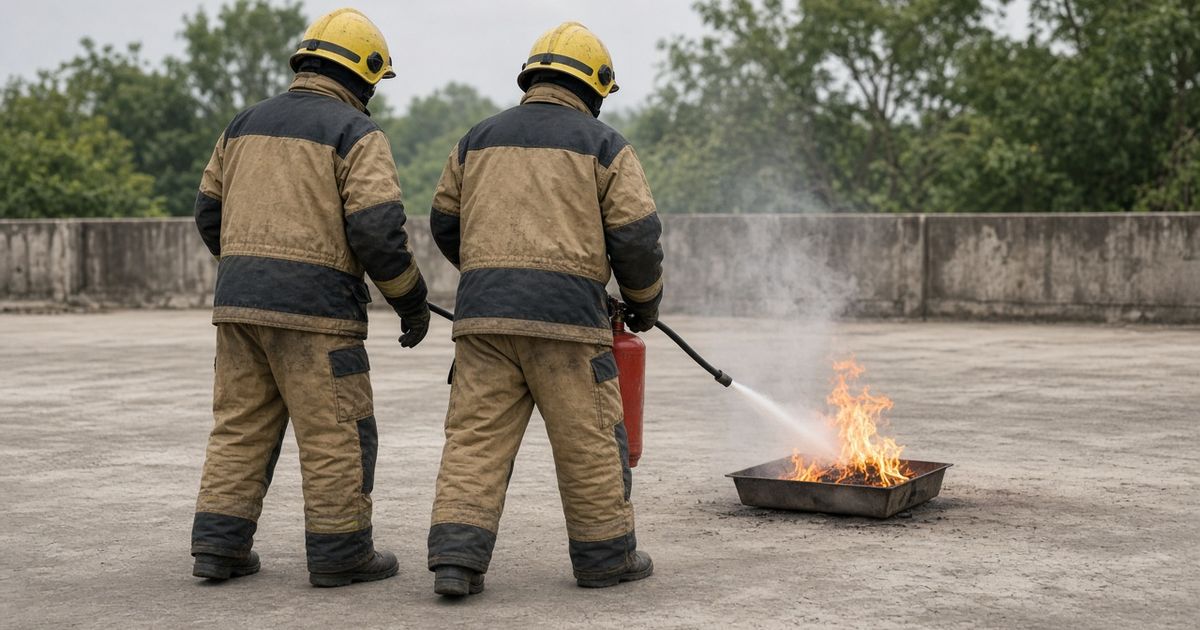
Fire and safety is a hands-on job, so practical training matters as much as theory. Before you join, visit the centre and ask what you will actually do with your hands: use fire extinguishers, wear and check PPE, practise fire drills and first aid. Ask how many hours of practical work the course has and where it happens.
Good questions to ask on your visit:
- Which equipment will I use myself, not just watch?
- How many practical sessions are in the course, and are they in the timetable?
- If I study online, where and when do practical or contact sessions take place?
- Who teaches the practical sessions, and what work experience do they have?
Which fire and safety course and duration fits you?
Pick the course that starts from your last qualification. After 10th, a short certificate is the usual start. After 12th or ITI, a 1-year diploma or a 12- or 18-month advanced diploma fits. Graduates can take a 1-year PG diploma. For a full degree, a 3-year B.Sc is an option. Always check the duration on the official course page.
Here is how this looks at NIFS, taken from the NIFS course pages:
| NIFS course | Duration | Who can join | Fees |
|---|---|---|---|
| Certificate Course in Fire & Safety (CCFS) | 3–6 months | 10th pass / 10+2 | Contact for fees |
| Diploma in Fire & Safety (DFS) | 1 year | 10+2 / ITI / any stream | Contact for fees |
| Advanced Diploma in Fire & Safety (ADFS) | 18 months | 10+2 / diploma (any stream) | Contact for fees |
| Advanced Diploma in Industrial Safety (ADIS) | 12 months | 10+2 / diploma (any stream) | Contact for fees |
| PG Diploma in Fire & Safety (PG DFS) | 1 year | Any graduate | Contact for fees |
| B.Sc in Fire & Industrial Safety | 3 years (6 semesters) | 10+2 / diploma (3 years) | Contact for fees |
All paid NIFS courses carry an Acharya Nagarjuna University (State Government University) certificate. See every option, with duration and eligibility, on the safety officer course page. If you are unsure whether you need a fire and safety course or a fire engineering degree, read fire engineering course vs fire and safety course.
Not sure which course fits you?
Send us your last qualification and city. Chat with NIFS on WhatsApp for course advice, fees and batch dates, or use the enquiry page. Want to try first? Take the free Ergonomic Safety course online.
How much does a fire and safety course cost?
Fees change with the course, the centre and the mode (online or classroom), so ask each institute for the full fee in writing. Make sure it includes the exam fee, certificate fee, study material and any practical or uniform charges. Compare the total amount, not just the first payment.
At NIFS, fees depend on the course and centre, so please contact us for the current fee. Never pay a large amount on the first visit only because someone says "seats are closing today".
How do you check placement claims?
Treat every placement promise as a claim to check, not a fact. Ask the institute what kind of placement support it gives, for example job openings, interview help or company visits, and ask for proof you can check yourself. Speak to former students on your own, not only to people the institute chooses for you.

- Ask: "Is placement support a promise of a job, or help to find one?" Get the answer in writing.
- Look for real job openings you can open and read, with company name and location.
- Be careful with any promise of a sure job. No institute can control an employer's decision.
At NIFS, you can see current openings on our jobs page.
Online or classroom: which is better for you?
Both can work. Classroom study suits you if you want daily practice and face-to-face teaching. Online study suits you if you work or live far from a centre. The value of the certificate depends on who issues it, not on the mode. If you study online, ask how and where you will get practical training.
Most NIFS course pages list both classroom and online modes. Ask your nearest centre which mode is open for your batch, and how practical sessions are planned.
What are the red flags of a fake fire safety institute?
Walk away, or at least slow down, if you see these signs: no clear certifying body, a university you cannot find on the UGC website, no practical training, no written fee, pressure to pay today, or promises of a sure job. A genuine institute is happy to answer questions and lets you check every claim.
- The certificate name keeps changing when you ask.
- Logos of government bodies, but no proof you can check online.
- No address you can visit, or the "centre" is only a phone number.
- A very short course sold with a big title like "engineer".
- Reviews or job claims that you cannot check anywhere.
Also read: government-recognised fire safety courses in India.
About NIFS India, the publisher of this guide
NIFS India (National Institute of Fire and Safety) has 25+ years in fire and safety training, 65+ centres in 20 states & UTs and 45,000+ alumni. NIFS is NSDC approved and ISO 9001:2015 certified, and all paid courses carry an Acharya Nagarjuna University (State Government University) certificate. Please check these claims with the same checklist you use for any institute.
Ready to check NIFS with this checklist?
Message NIFS on WhatsApp to ask about approvals, fees, batch dates and your nearest centre, or fill the enquiry form. You can also begin today with the free Ergonomic Safety course with certificate, and browse openings on the jobs page.
Companies Currently Hiring Through NIFS
DETECT TECHNOLOGY
SAFETY OFFICER
KPC PROJECTS LTD
3 positions open
Frequently Asked Questions
How do I choose a fire and safety institute in India?
Check who issues the certificate (a university or a government-approved body), whether you get hands-on practical training, the course length and eligibility, the full fee in writing, and proof behind any placement claim. Visit the centre before you pay.
How can I check if a fire and safety institute is government recognised?
Ask for the exact name of the certifying university or body in writing. Then check a university in the lists on the UGC website (ugc.gov.in), skill approval on the NSDC website and Skill India Digital Hub, and engineering colleges with "Verify Institute Approval" on the AICTE website.
What is the fee for a fire and safety course at NIFS?
Fees depend on the course, centre and mode, so NIFS does not list them online. Contact NIFS on WhatsApp (+91 83743 40999) or the enquiry page for the current fee, and ask any institute for the full fee in writing.
Is an online fire and safety course valid?
The value of a certificate depends on who issues it, not on whether you studied online or in a classroom. Check the certifying body on its official website, and ask how and where you will get practical training.
Why does this guide not rank fire and safety institutes?
This guide is published by NIFS India. Because NIFS is a fire and safety institute itself, we give a checklist you can use on any institute, including NIFS, instead of a ranking of other institutes.
Start Your Career in Industrial Safety Today
NSDC-approved Diploma, Advanced Diploma, and Degree programs with a dedicated placement cell.