AI Can Make Work Safer—But Who Is Assessing the Risks Created by AI?
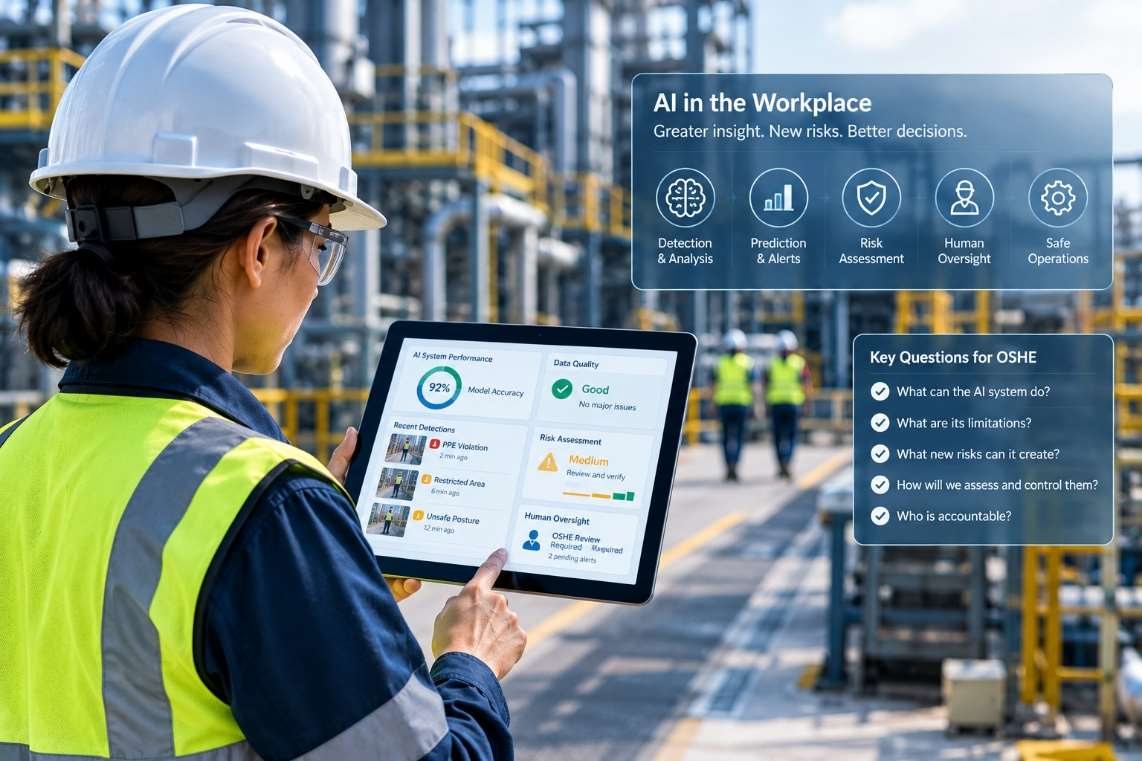
The next OSHE challenge may not be using AI. It may be assessing the risks created by using it. Artificial intelligence is increasingly being introduced into workplaces to detect hazards, monitor conditions, predict failures, support decision-making and reduce exposure to dangerous work. The safety potential is real. But there is another question that OSHE professionals need to ask: if AI is introduced to make work safer, who assesses the risks created by the AI itself?
A contributed article by Manoj Kumar Sharma, Assistant Professor, Department of Fire and Safety, Acharya Nagarjuna University (ANU) – Guntur, in academic collaboration with the National Institute of Fire and Safety (NIFS), Visakhapatnam.
Key takeaways
- AI belongs inside the risk assessment. An AI safety tool can detect, miss or introduce hazards, so it must be assessed like any other control.
- Move from "AI for Safety" to "Safety of AI". Ask whether the AI itself is understood, tested and controlled for your workplace.
- It is a team job. OSHE, engineering, IT or AI, operations, workers, management and the AI vendor each own a part.
- Always have a fallback that works when the AI is wrong or unavailable.
This question matters because AI does not simply observe a workplace. It can change how work is organised, how decisions are made, how workers interact with machines and, in some applications, how safety-critical systems operate. The International Labour Organization (ILO) has highlighted both the opportunities and emerging risks associated with AI, automation and digitalisation, calling for proactive and adaptive approaches to managing their occupational safety and health (OSH) implications [1].
AI Is Not Outside the Risk Assessment
Traditional risk assessment generally asks: What can go wrong? → Who can be harmed? → How severe could the outcome be? → What controls are required? When AI becomes part of the workplace, the same logic needs to extend to the AI-enabled system.
| Traditional OSH question | AI-enabled workplace question |
|---|---|
| What hazard exists? | What hazard can the AI system detect, miss or introduce? |
| Is the control effective? | Can the AI control behave unexpectedly? |
| Who makes the decision? | Who is accountable for the AI-supported decision? |
| What happens if the control fails? | What happens if the AI fails, drifts or produces an incorrect output? |
| How are workers affected? | How does AI change work, autonomy, workload or human–machine interaction? |
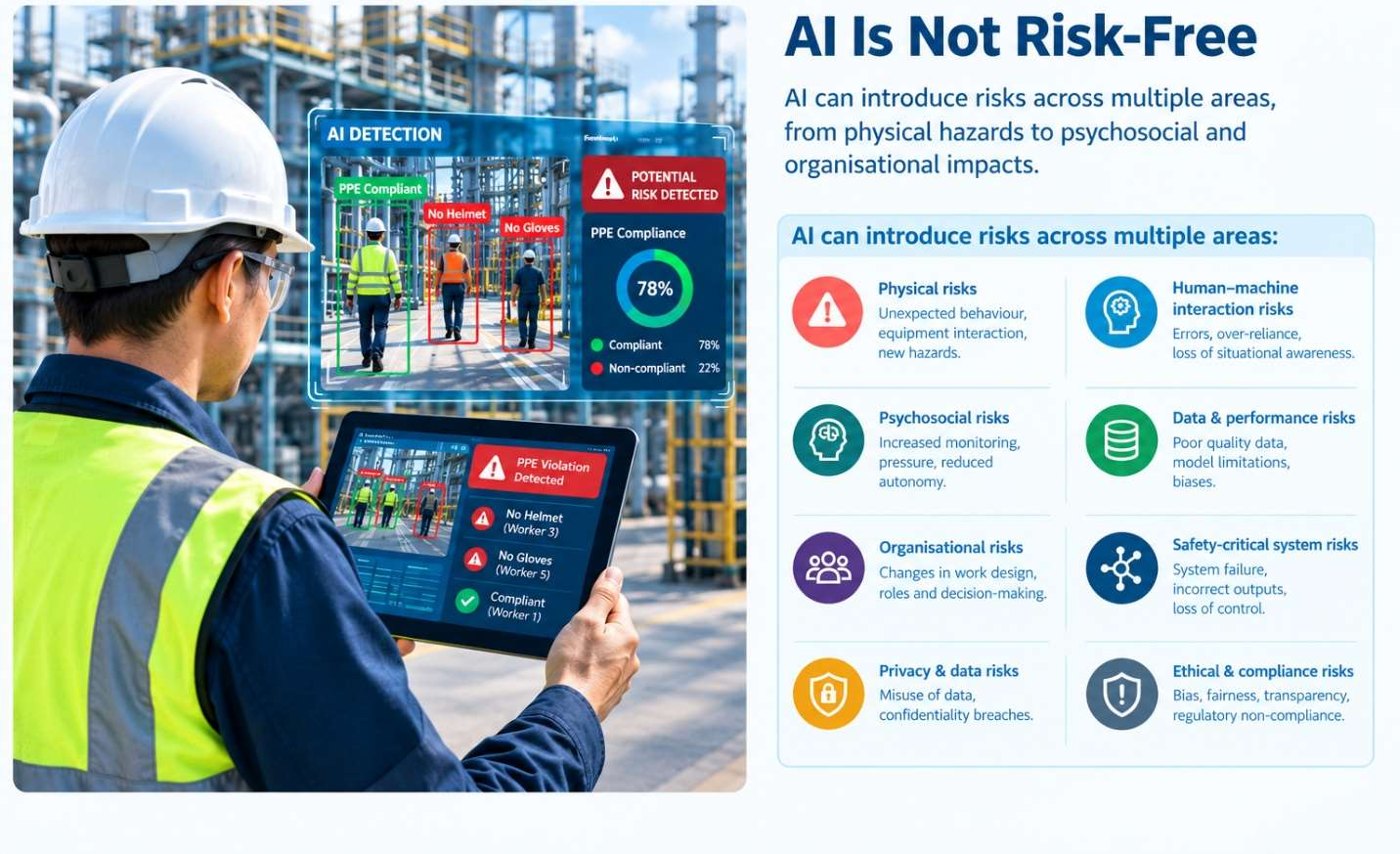
A 2024 peer-reviewed commentary in the American Journal of Industrial Medicine notes that workplace AI adoption can produce a broad range of physical, mental, psychosocial, economic and ethical risks. It also highlights that risks may arise at different stages of the AI lifecycle and may become operational characteristics of the system once deployed [2]. That changes the role of OSHE.
From "AI for Safety" to "Safety of AI"
The question should no longer be only: How can AI improve safety? It should also be: Is the AI system itself sufficiently understood, tested and controlled for the workplace in which it is being used?
The National Institute for Occupational Safety and Health (NIOSH) has discussed the idea of applying established occupational hazard-identification and exposure-assessment principles to algorithmic systems. The objective is not to create a completely separate safety discipline, but to understand how characteristics of algorithmic systems can interact with existing workplace hazards and controls [3].
A practical AI-OSHE risk assessment flow
- AI system proposed.
- Define its purpose and operating boundaries.
- Identify what the AI can influence.
- Identify failure modes, limitations and unintended consequences.
- Assess worker exposure and potential consequences.
- Consult workers, OSHE and technical teams.
- Define engineering, administrative and software controls.
- Validate before deployment.
- Monitor performance and incidents.
- Reassess when the AI, workplace or work process changes.
What Risks Should OSHE Professionals Look For?
AI-related risks will vary by application, but several questions should become part of the assessment.
1. Data and performance
What happens if the training or operational data are incomplete, poor quality or no longer representative of the workplace? An AI system can produce a technically valid output from inadequate data and still lead to an unsafe decision.
2. Human–machine interaction
Does AI change how workers interact with equipment, automation or safety systems? A change in task allocation or decision authority can create new human–machine relationships that require assessment [2].
3. Over-reliance
Could workers or supervisors begin treating AI recommendations as authoritative rather than advisory? The presence of an AI recommendation should not eliminate professional verification where the consequence of error is significant.
4. Psychosocial and organisational risks
AI can alter work intensity, autonomy, monitoring, task allocation and the organisation of work. These changes can themselves become relevant OSH considerations.
5. Failure and fallback
The most important question may be: What happens when the AI is wrong, or unavailable? Every safety-critical AI application should have a defined fallback method that does not depend on the AI functioning correctly.
Who Should Assess the Risk?
AI risk should not become the responsibility of the IT department alone. It requires a multidisciplinary approach.
| Function | Key responsibility |
|---|---|
| OSHE / OEHS | Hazard identification, exposure, controls and worker safety |
| Engineering | System integration and technical safeguards |
| IT / AI team | Model performance, cybersecurity, data and system behaviour |
| Operations | Real-world operating context |
| Workers | Practical experience, usability and unintended consequences |
| Management | Governance, resources and accountability |
| AI vendor | System limitations, validation information and software controls |
The AI Risk Management Framework of the National Institute of Standards and Technology (NIST) reinforces this lifecycle approach by encouraging organisations to address AI risks across design, development, deployment, use and evaluation, with functions organised around Govern, Map, Measure and Manage [4].
"Do not wait for an AI-related incident before treating the AI system as part of the risk assessment."
A New OSHE Question
A 2026 systematic review of AI in occupational health and safety identified 43 peer-reviewed studies across applications including risk prediction, PPE detection, ergonomic monitoring and hazard prevention. At the same time, the review identified continuing challenges involving data quality, ethical considerations and standardisation, and called for attention across the AI lifecycle [5].
This suggests that the future OSHE professional may need to ask two sets of questions:
- Workplace risk: What can harm the worker?
- AI-enabled risk: How can the AI system change, create, hide or amplify that harm?
That second question is likely to become increasingly important as AI moves from being an analytical tool to becoming part of operational and safety-critical systems.
The Future: AI-Assisted Safety Needs AI Risk Governance
- AI can make safety systems faster, more predictive and more data-driven.
- But safer technology does not automatically mean a safer system.
- The objective should not be to reject AI, or to accept it uncritically.
- It should be to assess it, test it, control it and continuously monitor it.
- For OSHE professionals, that means expanding the traditional risk-assessment mindset.
- Don't only assess the hazards AI is designed to detect. Assess the hazards that AI may create, influence, conceal or amplify at the workplace.
- Because when AI becomes part of the workplace safety system, the AI itself becomes part of the safety system that must be assessed.
5 questions to ask before an AI safety tool goes live
- What is its purpose and where are its operating boundaries?
- What can it detect, miss or introduce, and what happens if its data is poor or out of date?
- Who is accountable for a decision the AI supports, and will people verify it when the stakes are high?
- What is the fallback when the AI is wrong or unavailable?
- Who monitors it, and when will it be reassessed as the AI, the workplace or the work changes?
Summarised from the framework above by NIFS. Share it with your safety team.
Learn the risk-assessment skill behind this
Hazard identification and risk assessment (HIRA) is the foundation every OSHE professional needs, with or without AI. It is covered hands-on in the Advanced Diploma in Industrial Safety (ADIS) at NIFS, and in the B.Sc in Fire & Industrial Safety offered with Acharya Nagarjuna University. See also our earlier reads on computer vision in industrial safety and predictive AI for safety in India.
References
- International Labour Organization (ILO), 2025. ilo.org
- Howard J, Schulte P. Managing workplace AI risks and the future of work. American Journal of Industrial Medicine. 2024;67(11):980–993. doi:10.1002/ajim.23653
- NIOSH / CDC, 2026. Practical Strategies to Manage AI Hazards in the Workplace
- National Institute of Standards and Technology (NIST). AI Risk Management Framework (AI RMF 1.0), 2023. nist.gov
- La Torre G, Manai MV, Meucci S, et al. Artificial intelligence and occupational health and safety: a systematic review. Journal of Public Health, 2026. doi:10.1007/s10389-026-02738-8
— Manoj Kumar Sharma
Assistant Professor, Department of Fire and Safety, Acharya Nagarjuna University (ANU) – Guntur
Companies Currently Hiring Through NIFS
KPC PROJECTS LTD
3 positions open
PON PURE CHEMICAL INDIA PRIVATE LIMITED
Safety Trainee
Frequently Asked Questions
What does it mean to assess the risks created by AI at work?
It means treating the AI system itself as part of the workplace risk assessment: asking what hazards it can detect, miss or introduce, how it can fail, and who is accountable for AI-supported decisions.
What is the difference between "AI for Safety" and "Safety of AI"?
"AI for Safety" asks how AI can improve safety. "Safety of AI" asks whether the AI system is sufficiently understood, tested and controlled for the workplace in which it is used.
Who should assess AI risk in a workplace?
AI risk should not be left to the IT department alone. It needs OSHE professionals, engineering, the IT or AI team, operations, workers, management and the AI vendor working together.
What should happen when a safety-critical AI system fails or is unavailable?
Every safety-critical AI application should have a defined fallback method that does not depend on the AI functioning correctly.
What are the main AI-related risks OSHE professionals should look for?
Data and performance problems, changes in human-machine interaction, over-reliance on AI recommendations, psychosocial and organisational effects, and failure and fallback planning.
Start Your Career in Industrial Safety Today
NSDC-approved Diploma, Advanced Diploma, and Degree programs with 100% placement assistance at top companies like L&T, Adani, and Reliance.