AI in Industrial Safety: How Computer Vision Is
Every industrial accident has two timelines. The first is the accident itself — a date, a time, photographs, a committee and an investigation report. The second timeline starts hours, days or even weeks earlier, built out of unnoticed signals and fragmented information sitting in departments that never spoke to each other. Traditional safety investigates the first timeline. AI in industrial safety investigates the second.
"Artificial Intelligence should never replace the safety professional. It should become the safety professional's most trusted companion."
What Happened at 10:17 AM
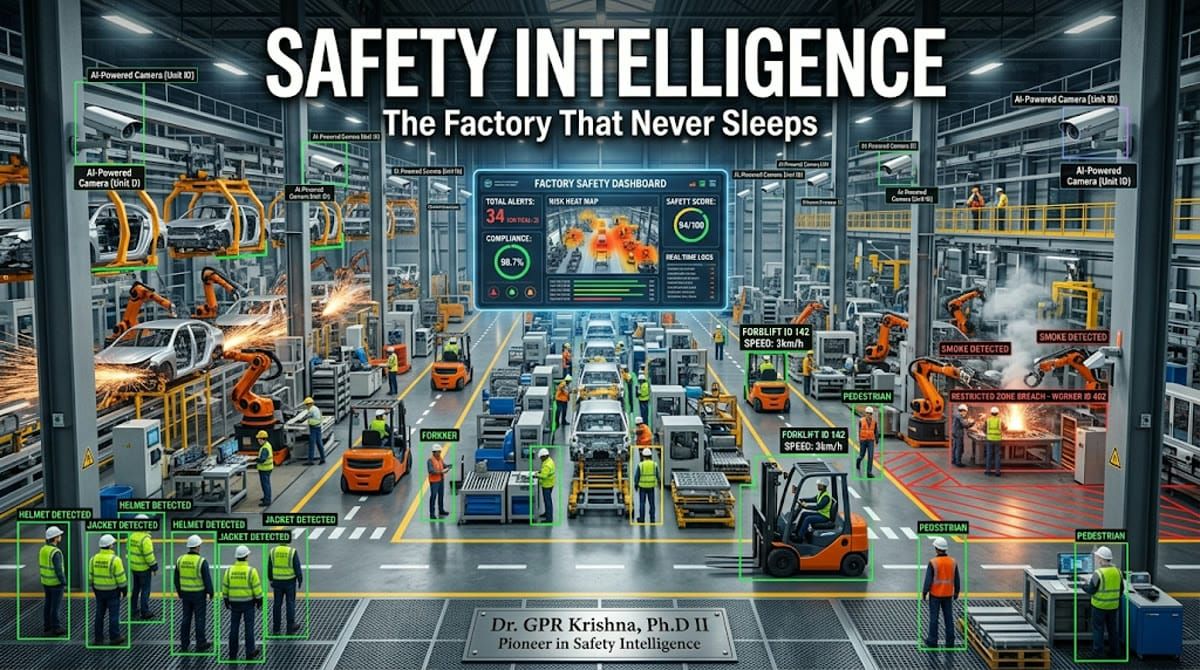
A busy automobile plant. More than 3,500 employees. Hundreds of contractors. Nearly 1,800 CCTV cameras quietly watching everything.
Inside Warehouse-3, a forklift driver is rushing to deliver material before the line stops. A maintenance technician walks into the same aisle, eyes on his tablet. At the far end, a welder starts hot work. Just beside him, a small quantity of hydraulic oil has leaked from a machine.
Nobody notices. Not the supervisor. Not the production manager. Not the safety officer. Everyone is busy. Production continues.
Then one camera notices something the humans did not. In the same frame, it picks up four things at once:
- A forklift approaching at speed
- A worker walking into its direct path
- Active welding sparks
- A combustible hydraulic oil spill on the floor
Within two seconds, a high-risk alert appears on the safety dashboard and an automated voice announcement goes out in that bay. The forklift operator brakes. The technician steps back. Welding is stopped. The spill is cleaned. Production resumes in four minutes.
No accident. No investigation. No compensation. No newspaper headline. This is not science fiction — this is computer vision for workplace safety in action.
The Camera That Only Speaks After the Accident
Most industries already own the largest safety monitoring system in the country. It hangs on the wall. It records continuously. It never takes leave. It is called CCTV.
Unfortunately, most organisations use it only after an accident — replaying footage, identifying the mistake, preparing the investigation report, and asking one painful question: "What happened?"
Safety Intelligence™ asks a completely different question: "What is happening right now?" That single change of tense changes the entire outcome.
Can One Safety Officer Watch Everything?
Take a plant with 4,000 workers, 750 contractors, 25 production lines, 16 warehouses, three shifts and round-the-clock operations. Now put one safety officer in charge of all of it. Can that person watch hundreds of monitors continuously, catching every missing helmet, every unsafe lift, every confined space violation?
The answer is obvious. Humans cannot watch everything. Machines can. This is not a criticism of safety officers — the limitation is not commitment, it is arithmetic.
Why AI Will Not Take Your Safety Officer's Job
The moment I say Artificial Intelligence in a plant meeting, the first question is always the same: "Sir, will this replace our safety officers?" Absolutely not.
AI cannot inspire a workman to speak up. It cannot build trust with a contractor gang. It cannot mentor a young engineer. It cannot sit with an injured worker's family. Only a human being does that work.
What AI does is different. It observes continuously, detects instantly, analyses rapidly and alerts immediately. It does not replace experience — it multiplies the reach of experience.
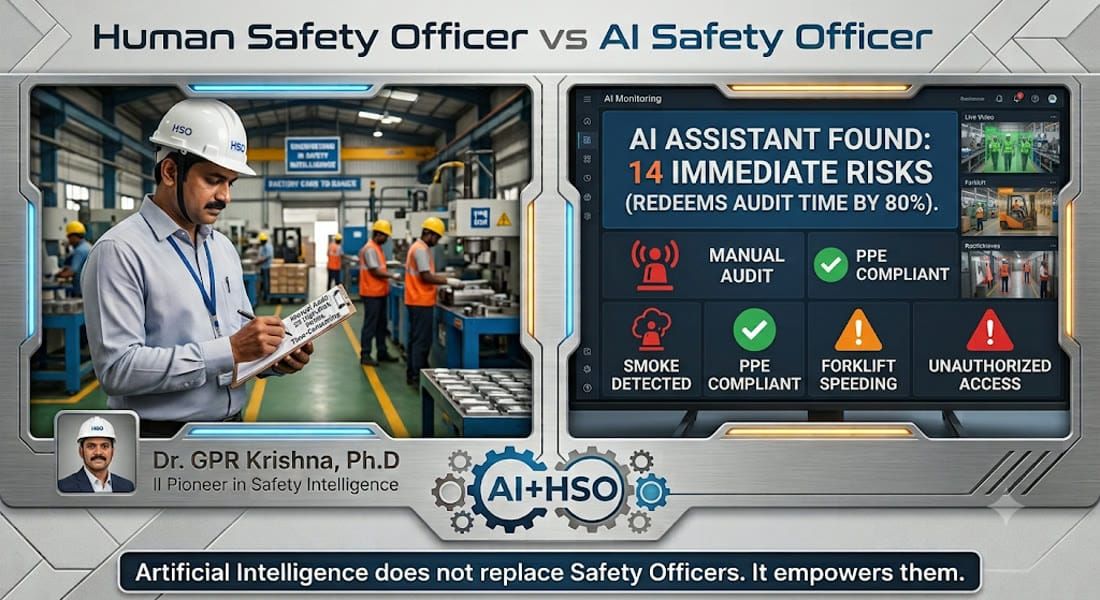
"Artificial Intelligence never replaces human wisdom. It expands human awareness."
What Computer Vision Actually Does
Think of it as giving eyes to a machine and then teaching that machine to understand what it is looking at. Within milliseconds, it can recognise helmets, safety shoes, reflective jackets, forklifts, smoke, flames, a person falling, a restricted area being entered, a crane in motion, a mobile phone in a hazardous zone, or a guard missing from a machine.
In simple words, computer vision lets a computer understand a photograph or a live video the same way we do — except it never blinks, never gets distracted, never gets tired and never looks away.
Did You Know?
A human observer starts losing concentration after long periods of continuous visual monitoring. An AI camera analyses thousands of video frames every minute without fatigue, which makes it particularly suited to repetitive monitoring in industrial settings.
What I Keep Noticing Inside Indian Plants
During my visits to manufacturing units across the country, one pattern repeats itself in almost every plant. Organisations invest crores in production automation — robotic welding lines, automated material handling, real-time production dashboards — and then expect one safety officer to monitor the entire factory with a notepad.
Production has moved to Industry 4.0. Safety, in many organisations, is still running on Industry 2.0. That gap is where accidents live.
"Every CCTV camera has eyes. Safety Intelligence™ gives it a brain."
The AI Safety Decision Cycle™: An Original Framework
Every accident follows a sequence. So does every accident that gets prevented. Traditional safety management usually enters after something has gone wrong — investigation begins, photographs are taken, reports are prepared. Lessons are learnt, but the fee is paid in injury, damage or downtime.
AI changes where the sequence begins. It steps in before the event, not after it. That is the whole idea behind the AI Safety Decision Cycle™, an original Safety Intelligence™ framework developed by Dr. GPR Krishna.
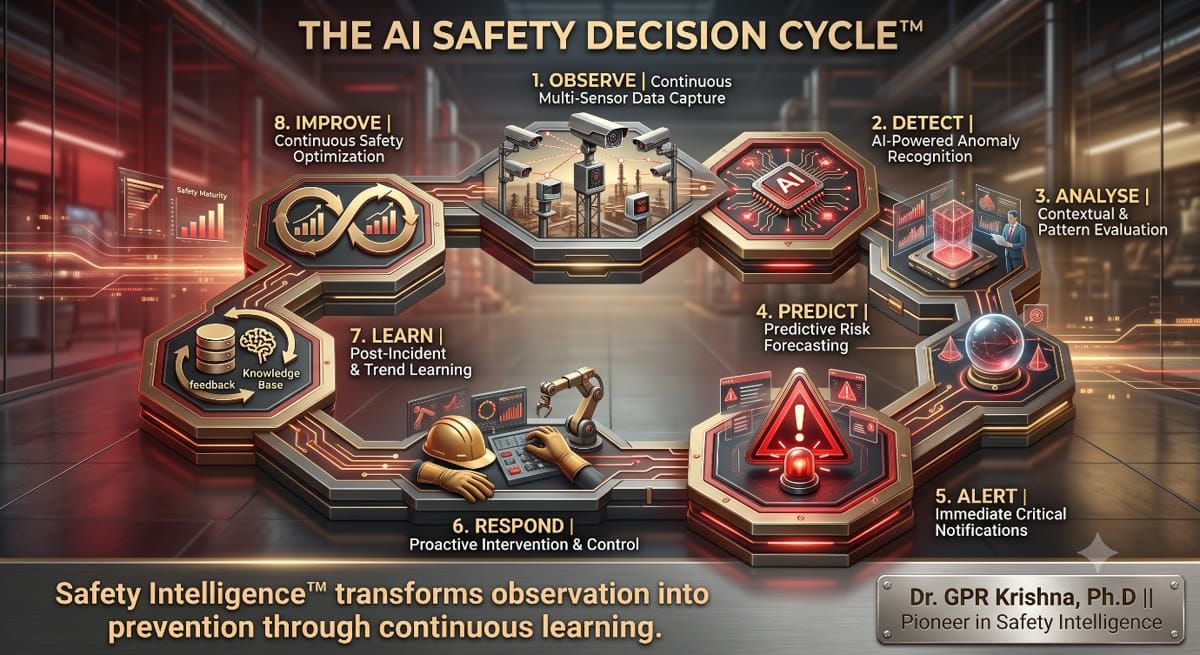
| Stage | What AI Does | What You Get |
|---|---|---|
| Observe | Monitors people, machines and work areas continuously | Complete workplace visibility |
| Detect | Picks up unsafe acts, unsafe conditions and abnormal situations | Early hazard identification |
| Analyse | Weighs severity using safety rules and past patterns | Intelligent risk assessment |
| Predict | Estimates the chance of an incident if nobody intervenes | Preventive decision making |
| Alert | Notifies the right person instantly | Faster response |
| Respond | Supervisors and safety teams act on the spot | Incident prevented |
| Learn | Stores every event to sharpen future recognition | Continuous organisational learning |
| Improve | Insights feed back into procedures, training and engineering controls | Sustained safety performance |
Safety moves from reaction to prediction. That one shift is the future of industrial safety.
"Traditional safety asks, 'What happened?' Safety Intelligence™ asks, 'What is about to happen?'"
Clearing the Five Common Myths
The biggest barrier to AI in safety is not cost or technology. It is misunderstanding. Let us settle the common ones.
| Myth | Reality |
|---|---|
| AI will replace safety officers | AI makes safety officers far more effective |
| CCTV is useful only after an accident | AI-enabled CCTV prevents accidents in the first place |
| AI is too expensive for our industry | One serious accident usually costs more than the preventive system |
| AI removes human judgement | AI supports human judgement with faster, cleaner information |
| Only large industries benefit | Any size can start with one or two high-risk areas |
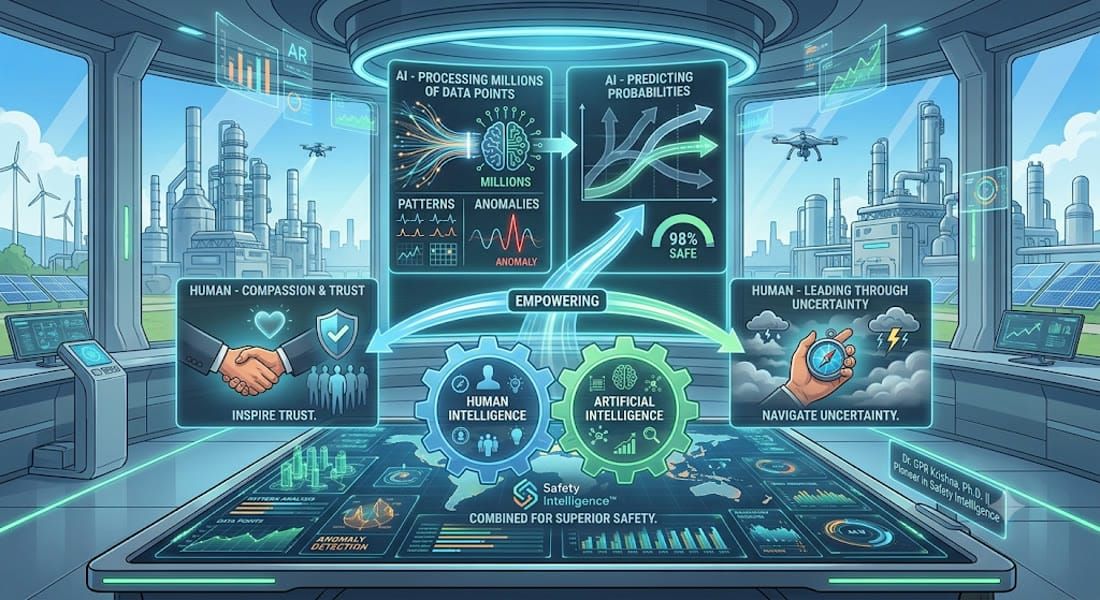
The point is not to replace people with machines. The point is to put human intelligence and machine intelligence on the same team. That combination is what I call Safety Intelligence™.
Where AI Works as Your Second Safety Officer
Computer vision has moved well beyond checking whether a worker is wearing a helmet. A modern system picks up dozens of workplace risks in real time.
(a) Personal Protective Equipment
- Helmet, reflective vest and safety shoe compliance
- Face shields, gloves and respiratory protection
(b) Unsafe Behaviour
- Running inside production areas
- Mobile phone usage in hazardous locations
- Unsafe manual handling and improper ladder usage
- Entry into restricted areas
(c) Fire and Emergency
- Smoke and flame detection
- Hot work monitoring
- Emergency exit obstruction and extinguisher accessibility
(d) Vehicle and Pedestrian Safety
- Forklift speed and route compliance
- Pedestrian interaction, blind spots and reverse movement alerts
(e) Housekeeping
- Oil spills, blocked walkways and material obstruction
- Waste accumulation and poor storage practice
(f) Machine Safety
- Missing machine guards and unsafe proximity
- Lockout-tagout violations and access during operation
A Day Inside an AI-Enabled Plant
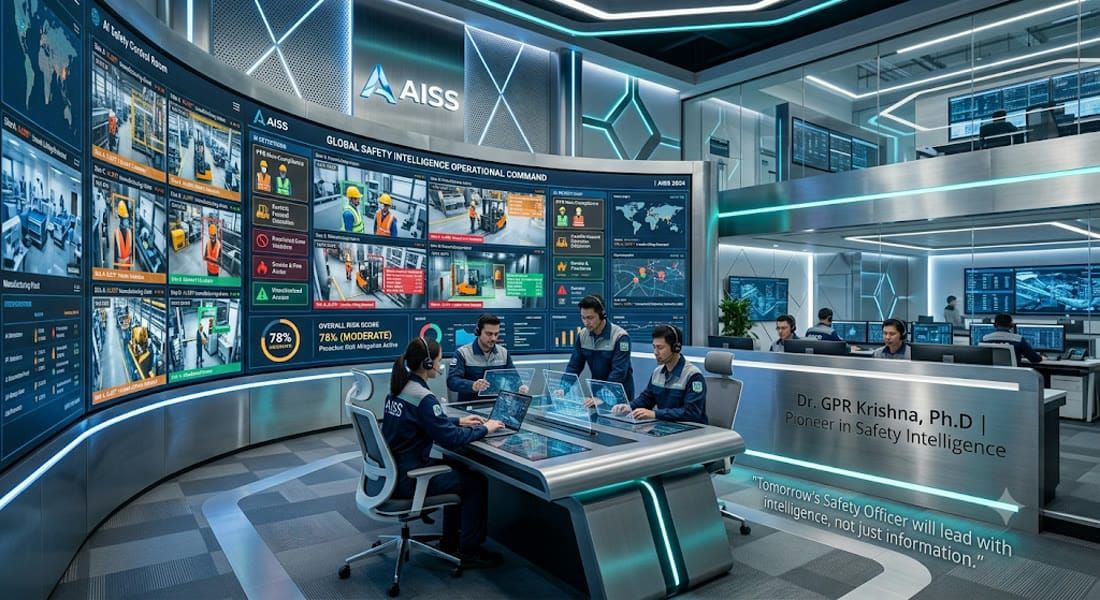
Walk into such a facility and at first glance nothing looks unusual. People are working. Machines are running. Forklifts are moving. What you cannot see is the layer working underneath: every camera analysing activity, every entry gate verifying PPE, every hot work job digitally supervised, every unsafe act feeding a live risk score for that area.
The safety officer is no longer hunting for hazards. The hazards are reaching the safety officer.
What One Month of AI Monitoring Revealed
An illustrative scenario, built from patterns seen repeatedly in large plants.
An automotive manufacturer with more than 4,500 workers across three shifts had a genuinely good safety record. Even so, management was uneasy about repeated near misses involving forklifts, pedestrians and contractors. They connected AI analytics to their existing cameras in high-risk areas. In the first month alone, the system flagged:
- 1,248 instances of missing helmets
- 842 unsafe pedestrian movements
- 396 forklifts crossing the designated speed limit
- 211 unauthorised entries into restricted maintenance zones
- 84 blocked emergency exits
- 17 minor smoke events during hot work
- 5 situations that needed immediate intervention
One of those five is worth describing in detail. During a maintenance shutdown, a contractor entered a restricted area without closing the permit-to-work formalities. At almost the same moment, another contractor started energising nearby equipment. The system recognised the dangerous combination immediately:
- A real-time alert appeared on the safety dashboard
- The maintenance supervisor received an instant notification
- The safety officer was directed to the exact location
- The activity was stopped before the equipment was energised
No injury. No production delay. No investigation committee. The incident never became an accident — and that is the entire value of prevention.
"The best accident investigation is the one that never becomes necessary."
The Commercial Case for the Boardroom
For many business leaders, safety is still filed under compliance and legal exposure. The organisations doing well are the ones that stopped looking at it that way. Every accident that does not happen shows up somewhere in the business:
- Higher productivity and less unplanned downtime
- Lower insurance and compensation costs
- Stronger employee confidence and retention
- Better customer and investor perception
- Cleaner ESG reporting and regulatory standing
AI in safety should not be judged only by the cost of the software. It should be judged by the value of what it prevents. The question is no longer "Can we afford AI?" The question is "Can we afford one more preventable accident?"
Starting Small: A Practical Roadmap
Many organisations hesitate because they assume this needs a full digital transformation. It does not. It needs a starting point.
| Phase | What You Do | How It Empowers You |
|---|---|---|
| Phase 1 | Identify your highest-risk locations | Effort goes where the exposure is |
| Phase 2 | Connect existing CCTV to AI analytics | Passive cameras become active monitoring tools |
| Phase 3 | Configure detection rules for your own hazards | Monitoring matched directly to your operations |
| Phase 4 | Train supervisors and safety officers | Confidence in interpreting and acting on AI alerts |
| Phase 5 | Review alerts, trends and closures every month | Measurable, continuing organizational improvement |
Successful implementation is not about buying sophisticated technology. It is about building a culture that trusts data while continuing to respect human judgement. NIFS India's Advanced Diploma in Industrial Safety (ADIS) now includes this exact AI-readiness roadmap as part of its risk assessment modules.
Is Your Organisation Ready?
Ten questions. Answer each one YES or NO, honestly:
- Do we have CCTV coverage in our high-risk areas?
- Are those cameras actively monitored, or only recording?
- Do we track leading indicators, not just LTIFR?
- Can we identify unsafe behaviours that keep repeating?
- Are near misses analysed for patterns?
- Are contractors monitored as rigorously as employees?
- Does safety information move across departments?
- Can leadership see a real-time safety picture?
- Do we use digital tools to support safety decisions?
- Are we preparing our safety officers for an AI-enabled plant?
Reading your score:
- 8 to 10 YES — You are ready to begin the Safety Intelligence™ journey.
- 5 to 7 YES — The foundation is there; integration is what is missing.
- Below 5 YES — Start with leadership commitment, data integration and proactive monitoring.
The Factory of 2035
Picture a plant ten years from now. Autonomous mobile robots move raw material. Collaborative robots work beside people. Digital twins mirror every process in real time. Wearables track fatigue, heat stress and vital signs.
Every forklift is geo-fenced. Every confined space entry is digitally verified. Every hot work permit is linked to the nearest fire protection system. The safety officer walks through that plant with confidence — not because the hazards are gone, but because every one of them is being watched, ranked and pushed to the top of the list when it matters.
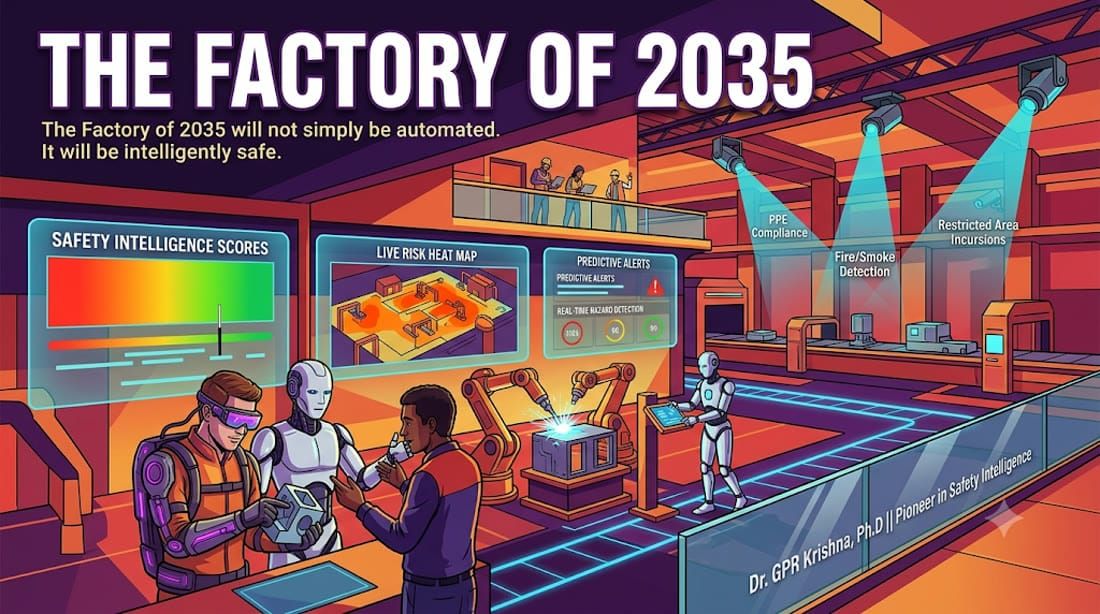
Finance uses AI. Marketing uses AI. Supply chain uses AI. Manufacturing uses AI. Industrial safety cannot afford to be the last department to make intelligent decisions.
"Technology does not create a safer workplace. Leaders who use technology wisely do."
Questions I Am Asked Most Often
Will AI replace safety officers?
No. It strengthens them. It watches continuously, flags hazards and gives real-time information. Leadership, communication, ethical judgement and final decisions stay with the professional.
Can our existing CCTV be converted?
In most cases, yes. Modern platforms integrate with existing camera infrastructure, so you get more out of an investment you have already made.
Which industries gain the most?
Manufacturing, automobile, pharmaceuticals, steel, cement, oil and gas, ports, logistics, mining, renewable energy, warehousing, construction and power generation.
Is it affordable for medium-sized plants?
Costs keep falling while capability keeps rising. Most organisations start in one or two high-risk areas and expand once the results are visible.
What is the single biggest advantage?
Continuous observation without fatigue. That alone transforms how early you catch unsafe acts and unsafe conditions.
Where should we begin?
Start with your highest-risk locations. Pick the safety problems that keep repeating. Use the cameras you already have. Set clear objectives, train your officers, measure, then expand. Practical beats rushed, every time — this is exactly the approach taught in NIFS India's Diploma in Health, Safety & Environment (DHSE) programme.
What to Take Away
- AI is not replacing safety professionals
- Computer vision turns ordinary CCTV into an active safety assistant
- Prediction is worth more than investigation
- Every unsafe act carries information; every near miss is a free lesson
- Safety Intelligence™ is human expertise plus machine intelligence
- The future belongs to organisations that predict risk instead of reporting it
A Call to Action
Every industrial revolution has been defined by one idea. Steam changed manufacturing. Electricity changed productivity. Computers changed business. Artificial Intelligence is now changing how we protect people.
The question is no longer whether AI will become part of industrial safety. The question is whether your organisation will lead that change or follow it. If you are a plant head, look at your highest-risk areas first. If you are a safety professional, build digital skills now. If you are a student, prepare for a profession that is changing faster than the syllabus.
Final Thought
Artificial Intelligence enhances safety by analysing data, detecting risks, and predicting hazards, while human intelligence provides leadership, trust, and ethical decision-making. Together, they form the foundation of Safety Intelligence™ — the future of achieving zero fatalities in Indian industries.
"Every camera has eyes. Every safety officer has experience. Safety Intelligence™ gives them the power to protect lives together."
Author: Dr. GPR Krishna, Ph.D. — GM Projects, IFESM, NIFS
Have Questions About Admissions, Eligibility, or Fees?
Chat directly with NIFS Official Career Advisors on WhatsApp for free counseling and course guidance.
Chat on WhatsApp (+91-8374-340-999)Companies Currently Hiring Through NIFS
NIFS/IFESM
SAFETY PROFESSIONAL
ROBOMATIC PRECON PVT LTD
SAFETY OFFICER
Beekay Steel Industries Ltd
Safety Officer
Frequently Asked Questions
Will AI replace safety officers?
No. AI strengthens safety officers rather than replacing them. It watches continuously, flags hazards and gives real-time information, while leadership, communication, ethical judgement and final decisions stay with the human professional.
Can our existing CCTV be converted for AI-based safety monitoring?
In most cases, yes. Modern AI analytics platforms integrate with existing camera infrastructure, so plants get more value out of an investment they have already made.
Which industries benefit most from AI-powered safety monitoring?
Manufacturing, automobile, pharmaceuticals, steel, cement, oil and gas, ports, logistics, mining, renewable energy, warehousing, construction and power generation all see strong results.
Is AI-based safety monitoring affordable for medium-sized plants?
Yes. Costs keep falling while capability keeps rising. Most organisations start with one or two high-risk areas and expand once results are visible.
What is the single biggest advantage of AI in industrial safety?
Continuous observation without fatigue. Unlike a human observer, an AI camera never gets tired or distracted, which transforms how early unsafe acts and unsafe conditions are caught.
Where should a plant begin its AI safety journey?
Start with your highest-risk locations, using the cameras you already have. Set clear objectives, train your safety officers, measure results, then expand.
Start Your Career in Industrial Safety Today
NSDC-approved Diploma, Advanced Diploma, and Degree programs with a dedicated placement cell.