The Future of Fire Fighting: Trends You Need to Know
INTRODUCTION
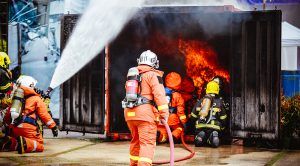 The trends in fire prevention technology that has emerged include enhanced fire detection systems, fire fighting, intelligent fire suppression systems, and use of Information and communication technologies in remote monitoring and controlling of fire detection systems. In regards to keeping high risk areas safe from fires, these systems are a true game changer. They are supposed to detect fires at the preliminary stage when they cannot trigger DEL and cause tremendous harm.
ADVANTAGES:
These fire accidents are real calamities in India thus demanding the formulation of a multi-sectoral strategic approach.
Amid appreciable advancement in the current scenario, increasing technological competence for fire-adjusted environments, and increasing awareness, the nation and place can knit the compos mentis of a more fire-safe platform.
But in this regard the fire fighting equipment industry has a very important role to play and the dynamism that characterises the fire fighting equipment market makes continuous development and innovation mandatory in order to cope with the Indian fire problems.
Over the last few years, the fire fighting equipment industry has recorded a lot of changes with the main objective of increasing the capacity of fire fighting equipments in terms of safety and efficiency.
NEW TRENDS OF FIREFIGHTING
- Fire-Resistant Materials
- Smart Helmets and Augmented Reality (AR).
- Fire Extinguishing Drones Safety
- High Pressure Water Mist Systems
- Robotic and Remote controlled System
- Thermal Imaging Cameras
- Even the PASS (Personal Alert Safety System) got its own Overhaul.
- Collaborative Robotics is also referred to as Cobots.
- Basic Information on Fire-Resistant: Fire-resistant foam technology
- Decision making tools for fire disaster prevention using Predictive analytics and AI.
- Small and ABCS Fire Extinguishers
- Mineral-based burn-resistant non combustible products
FIRE-RESISTANT MATERIALS
Graduate innovation of more sophisticated fire protective fabrics which are used in the firefighter apparel for heat protective outer garments as well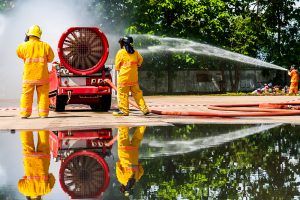 as flame protective fabrics for clothing of the fire fighters.in high-temperature environments. Thermal resistant fabrics as some of them melt rather than burning when exposed to heat. Popular synthetic fibers include:
- KEVLAR: An organic fiber that has the additional characteristic of fire retardant.
- NOMEX: A fire protection clothing will consist of nylon / polyester blend.
- MODACRYLIC: A blend of para-aramid, lyocell or polyamide-imide fibres that offers wear and tear, fire protection, and chemical and solvent resistance
- ALUMINIZED FABRICS: These fabrics can guard against heat emitted and transmitted to up to 1650° Throughout this paper, ample evidence in support of fire resistant fabrics is presented.
SMART HELMETS AND AUGMENTED REALITY (AR)
Smart helmets with augmented reality (AR) technology can help firefighters see through smoke and improve rescue efficiency. AR technology creates realistic fire scenes, allowing firefighters to see through heavy smoke. AR helmets can use 3D simulation imaging, thermal camera tracking, and human-computer interaction technology.
FIRE FIGHTING DRONE
Use of drones equipped with fire-extinguishing capabilities for rapid response to wildfires and industrial fires. These drones can reach inaccessible areas and deliver fire retardants or water to suppress flames from the air. Fire extinguishing drones can be used in both wildland and urban fires. They can help firefighters in a variety of ways, including:
- Early fire detection
- Situational awareness
- Identifying people in danger
- Locating exits
- Preventing the escalation of the fire
- Providing firefighters with safer access to the area
Robots and Remote-controlled equipment.
Firefighting robots and remotely operated vehicles are used to perform in risky situations. They include cameras, sensors and firefighting equipment that can be used to evaluate conditions, search for entrants and extinguish fires in zones that are hard to access by man.
Robots are being used in firefighting to help firefighters in a number of ways, including:
- FIRE DETECTION: The same applies to fire detection and identification of fires by robots before they spread.
- HAZARD ASSESSMENT: Robots can identify the risks in a building and send pictures of the fire scene to fire-fighters.
- FIRE SUPPRESSION: In particular, robots can apply water or foam to eliminate fire as a tool.
- SEARCH AND RESCUE: Multi use utility Robots can assist in rescue operations.
- SAFETY: Structures that are too risky for firemen and other personnel can be entered by robots, therefore the fire fighters.
High pressure water mist systems are a type of fire protection system.
Implementation of high-pressure water mist systems that actually release droplets of water to contain fires.
The product is efficient in extinguishing several of kinds of fires with minimal water provision and impacts to property.
THERMAL IMAGING CAMERAS
Already there are quite a number of improvements in thermal imaging in firefighting measures where a firefighter is able to see through smoke and even at night.
This is mostly used in finding victims, analysing the spot of the fire and more so help in movement through areas affected by the fire.
Upgrades of Personal Alert Safety System (PASS)
Adopting of miniaturized smart sensors and electronics interfaces for PASS devices used by fire-fighters. Such advancement entails distress signal transmission; geographical positioning system; and, safety, monitor and alarm for fire-fighters’ safety and fast rescue.
Collaborative Robotics also commonly referred to as cobots.
Application of cooperative telerobotics is done concurrently with human fire fighters. Such cobots can help to transport tools, do surveillance, and control the external climate while relieving the load of flame-fighters. Cobotic work refers to a type of robotic cooperation with operators to deal with challenging procedures explained under collaborative robotics. The use of cobots in industries helps to make interaction between human and robots frequently in the factories.
Fire Resistant Foam Technology
Synthesis of advanced generation fire resistant foam formulations used in combating flammable liquid fires is a good fire fighting system. These foams provide a shield that minimizes the chances of a flame breaking out and improve the efficiency of the fight against fires.
PREDICTIVE ANALYTICS AND ARTIFICIAL INTELLIGENCE FOR PROMOTING FIREFIGHTING
Fire Hazard Resilience Application of key strategic technologies such as artificial intelligence (AI) coupled with predictive analytics for priority cases to detect fire risks before they reach critical levels. These systems are capable of drawing information from various sources, for example from the sensors and from historical information to note patterns as well as fire risks.
Compact and Portable fire extinguishers.
Portable fire extinguishers present a double benefit in the fields of human life protection and environmental conservation. These devices give a chance to stop the development of fires, and can reduce the amount of harm that fire leaves on the environment. New models of fire extinguishers that can be easily moved around with compact size, together with newer functionalities like the longer range nozzles, the safe and environmentally friendly materials used to put out the fire, and simpler mechanisms to use the fire extinguisher.
CONCLUSION
The fire industry at large responsible for protection of life and property changes with time to fit emerging complexities. Many trends define its landscape ranging from technological innovations to sustainability mechanisms. The use of IoT and AI brings brand new perspectives and ideas in the sphere of fire safety. This is the premier institute in India in matters regarding firefighting and hence the institute is concerned with new trends in firefighting and has put in place new tools and firefighting systems.
Have Questions About Admissions, Eligibility, or Fees?
Chat directly with NIFS Official Career Advisors on WhatsApp for free counseling and course guidance.
Chat on WhatsApp (+91-8374-340-999)Ready to Start Your Career in Fire & Industrial Safety?
Explore NIFS government-recognized and NSDC-approved diploma programs.
Companies Currently Hiring Through NIFS
NIFS/IFESM
SAFETY PROFESSIONAL
ROBOMATIC PRECON PVT LTD
SAFETY OFFICER
Beekay Steel Industries Ltd
Safety Officer
Frequently Asked Questions
What are the eligibility requirements for The Future of Fire Fighting: Trends You Need to Know at NIFS?
Eligibility ranges from 10th pass for certificate courses to 12th science or ITI/Diploma/Degree for advanced safety diplomas. Counselors verify certificates during admission.
Are NIFS Fire and Safety programs NSDC and university recognized?
Yes, NIFS courses are NSDC-approved, recognized by PSU, private industrial employers, and overseas firms in Gulf countries.
Does NIFS provide placement assistance after course completion?
Yes, NIFS has a dedicated placement cell and 45,000+ alumni.
Start Your Career in Industrial Safety Today
NSDC-approved Diploma, Advanced Diploma, and Degree programs with a dedicated placement cell.