
Safety Officer Qualification: Section 40-B vs OSH Code

A Safety Officer is not simply a person who wears a helmet, conducts toolbox talks and prepares inspection reports. On the shopfloor, a Safety Officer carries a statutory responsibility connected with protecting men, material, machinery and methods — which is exactly why qualification matters, and why one question should come before paying any course fee: will this qualification actually make you eligible for the Safety Officer position you're applying for?
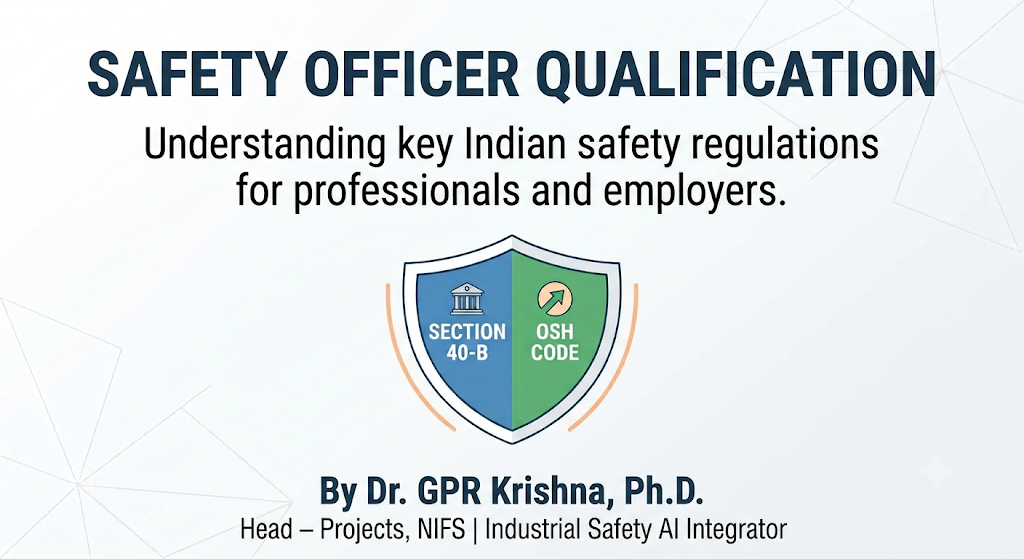
Quick Answer: Safety Officer Qualification in India
Over the years, students and working professionals collect different safety certificates without asking one fundamental question first — and that question should come before enrolling anywhere.
Section 40-B: The Foundation
For years, Safety Officer appointments in Indian factories followed Section 40-B of the Factories Act, 1948. It provided for the appointment of Safety Officers in factories meeting prescribed conditions — including factories employing 1,000 or more workers, or factories involving hazardous processes where the State Government required Safety Officers. The qualifications, duties and conditions of service were prescribed through applicable state rules.
This created an important principle: a Safety Officer appointment is not merely an HR designation — it is a regulated safety function. The Indian legal framework has since moved forward.
The New Legal Framework: OSH Code 2020
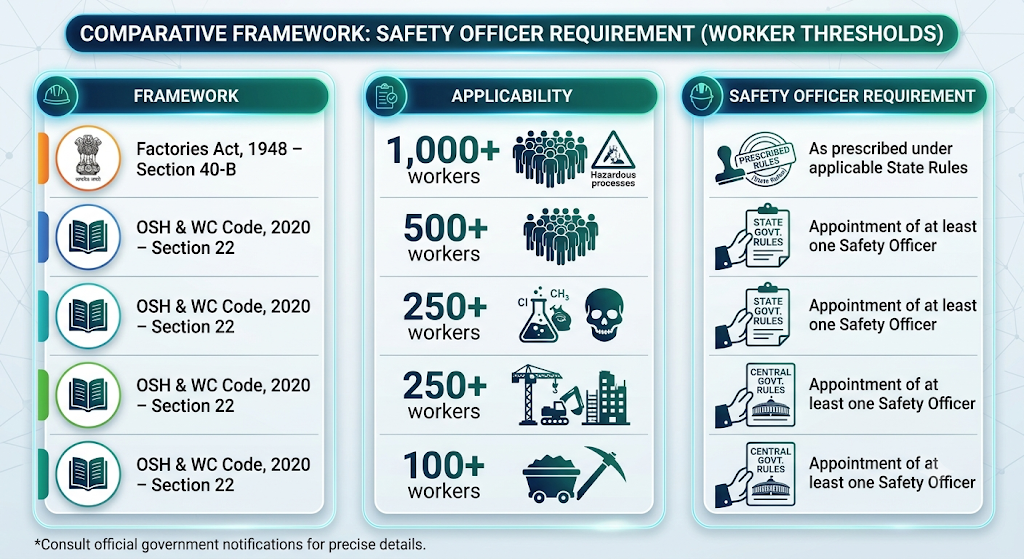
The Occupational Safety, Health and Working Conditions Code, 2020 came into force on 21 November 2025. Section 22 of the Code now provides for Safety Officers in specified establishments:
- Factories employing 500 or more workers
- Factories carrying on hazardous processes employing 250 or more workers
- Building and construction work employing 250 or more workers
- Mines employing 100 or more workers
The employer, contractor or vendor must appoint the prescribed number of Safety Officers possessing the qualifications and performing the duties prescribed by the appropriate Government. Whether a Safety Officer is mandatory in a specific factory depends on the applicable framework, establishment category, worker strength, and relevant rules or notifications.
| Framework | Applicability | Safety Officer Requirement |
|---|---|---|
| Factories Act, 1948 — Sec 40-B | 1,000+ workers, or notified hazardous processes/operations | As prescribed under applicable State Rules |
| OSH & WC Code, 2020 — Sec 22 | Factory: 500+ workers | As prescribed by appropriate Government |
| OSH & WC Code, 2020 — Sec 22 | Hazardous process factory: 250+ workers | As prescribed by appropriate Government |
| OSH & WC Code, 2020 — Sec 22 | Construction: 250+ workers | As prescribed by appropriate Government |
| OSH & WC Code, 2020 — Sec 22 | Mine: 100+ workers | As prescribed by appropriate Government |
*Consult official government notifications for precise, state-specific details.
A Certificate Is Not Always a Statutory Qualification
This is where many students get confused. There are hundreds of safety-related courses available today — Fire Safety certificates, Industrial Safety certificates, NEBOSH, IOSH, occupational health and safety courses, international professional certifications, online safety programmes, diploma and postgraduate programmes, and advanced diploma programmes. Many provide valuable knowledge. But knowledge value and statutory eligibility are not necessarily the same thing. For a specific Safety Officer position, the employer must verify whether a candidate's education, technical qualification, industrial safety qualification and experience satisfy the applicable law and regulations.
Where Does ADIS Fit?
The Advanced Diploma in Industrial Safety (ADIS) has traditionally occupied an important position in India's statutory safety profession. DGFASLI states that ADIS/PDIS/DIS courses conducted through the Central Labour Institute, Mumbai, and Regional Labour Institutes at Chennai, Faridabad, Kanpur and Kolkata — along with equivalent curricula designed by government universities — are recognised as statutory qualifications for appointment as Safety Officers under the Factories Act framework.
The DGFASLI programme is not merely a classroom certificate. Its structure involves classroom learning, discussions, case studies, laboratory exercises, practical yard training, factory visits, project/term work and examination. A professional safety qualification should prepare you for the shopfloor — not just accompany a certificate.
NEBOSH and IOSH: Know Their Place
International certifications can add considerable professional value depending on your career objective, industry and target market. But a student should never assume that an international certificate automatically replaces the statutory or academic qualification required for a specific Safety Officer appointment in India. Before joining any course, ask: "What jobs will I actually get with this qualification?" That one question can save a student — and a parent's hard-earned money.
The Qualification Checklist
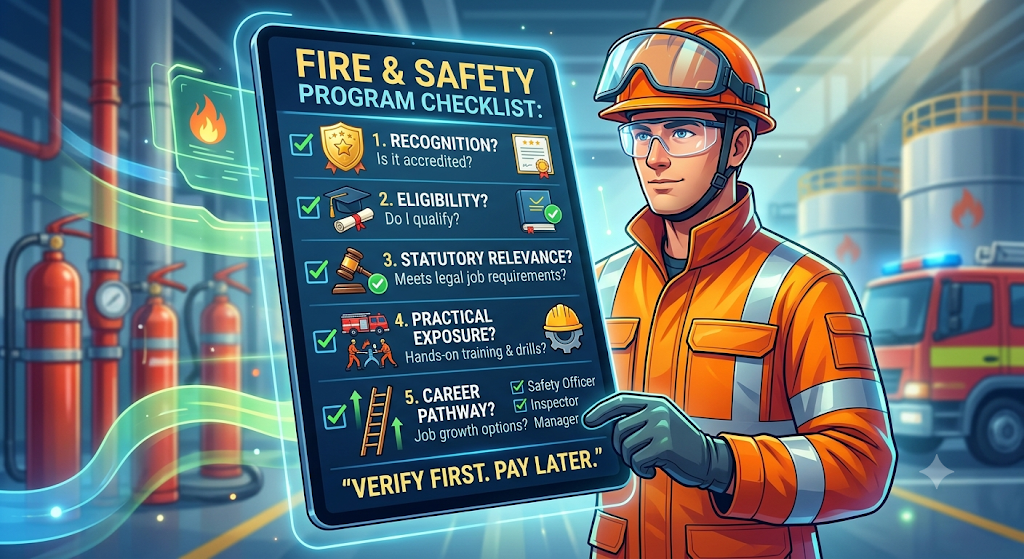
Before enrolling in any Fire & Safety program, check five things:
- Recognition: Who awards the qualification? Is the institution or university properly recognised?
- Eligibility: What educational background is required?
- Statutory relevance: Does this qualification meet the requirements of the Safety Officer role you want?
- Practical exposure: Does the program include classroom training, industrial visits, practical yard training, emergency drills and real workplace learning?
- Career pathway: After completing this course, what posts can you actually apply for?
"Verify first. Pay later."
The Real Responsibility of a Safety Officer
A real Safety Officer must be capable of understanding hazards beyond compliance — identifying unsafe conditions, calculating risks, understanding statutory requirements, inspecting workplaces, investigating incidents, empowering workers, communicating with management, and responding effectively during emergencies. A Safety Officer must also have the professional confidence to report serious unsafe conditions, escalate critical risks, and ensure statutory records and requirements are properly addressed.
"A certificate may open a door for you — competence keeps you inside."
That is how a career should build progressively: Education → Qualification → Practical exposure → Industrial experience → Career growth — not certificate after certificate chasing a job expectation.
Take Away
Follow the applicable Indian safety regulations first — understand Section 40-B of the Factories Act, the OSH & WC Code 2020, and other relevant statutory requirements before choosing a career qualification. A certificate may support your career, but statutory relevance, practical competence and professional responsibility remain the foundation.
If you have 0–3 years of experience, don't rush to become a Safety Manager. Become an excellent Safety Professional first, following the principle:
"FIRST ENTER → BE STABLE → BUILD COMPETENCE → THEN PROGRESS"
Let career progression follow naturally: Safety Officer → Senior Safety Officer → Safety Executive/Manager → Safety Manager → EHS Manager → Corporate Safety Leadership. The qualification on your wall matters — but your knowledge of the law, competence in the field and responsibility in your actions matter even more. India needs competent Safety Professionals, not certificate collectors.
Need guidance on building your Fire & Industrial Safety career? Reach the author directly on WhatsApp: +91-9989315222 — Dr. GPR Krishna, Ph.D., Head of Projects, NIFS.
References: (1) Occupational Safety, Health and Working Conditions Code, 2020 — India Code, Ministry of Labour & Employment. (2) Factories Act, 1948 — Section 40-B, Safety Officers — India Code. (3) DGFASLI — ADIS/PDIS/DIS: Statutory Qualification for Safety Officers.
Companies Currently Hiring Through NIFS
NIFS/IFESM
SAFETY PROFESSIONAL
ROBOMATIC PRECON PVT LTD
SAFETY OFFICER
Beekay Steel Industries Ltd
Safety Officer
Frequently Asked Questions
What is Section 40-B of the Factories Act, 1948?
Section 40-B is the older statutory provision requiring Indian factories meeting prescribed conditions — including factories with 1,000 or more workers, or hazardous-process factories notified by the State Government — to appoint qualified Safety Officers, with qualifications, duties and conditions of service prescribed through applicable state rules.
When is a Safety Officer mandatory under the OSH Code 2020?
Under Section 22 of the Occupational Safety, Health and Working Conditions Code, 2020 (in force since 21 November 2025), a Safety Officer is required for: factories with 500+ workers, hazardous-process factories with 250+ workers, construction work with 250+ workers, and mines with 100+ workers — as prescribed by the appropriate Government.
Is ADIS a statutory qualification for a Safety Officer role?
Yes — DGFASLI recognises ADIS/PDIS/DIS courses conducted through the Central Labour Institute, Mumbai, Regional Labour Institutes, and equivalent government-university curricula as statutory qualifications for appointment as Safety Officers under the Factories Act framework.
Does a NEBOSH or IOSH certificate replace India's statutory Safety Officer qualification?
No. International certifications like NEBOSH and IOSH add real professional value, but they do not automatically replace the statutory or academic qualification required for a specific Safety Officer appointment in India — always verify what a course actually makes you eligible for before enrolling.
What should I check before enrolling in a Safety Officer or Fire & Safety course?
Check five things: (1) Recognition — who awards it and is the institution properly recognised, (2) Eligibility — what educational background is required, (3) Statutory relevance — does it meet the requirements of the role you want, (4) Practical exposure — classroom training, industrial visits, drills and real workplace learning, and (5) Career pathway — what posts you can actually apply for afterward.
Start Your Career in Industrial Safety Today
NSDC-approved Diploma, Advanced Diploma, and Degree programs with a dedicated placement cell.