Safety Intelligence: From Cameras to Copilots
From Dr. Krishna's Desk
There was a time when a CCTV camera was considered a safety improvement. Then came recording, remote monitoring and dashboards. Now the camera is beginning to understand what it sees.
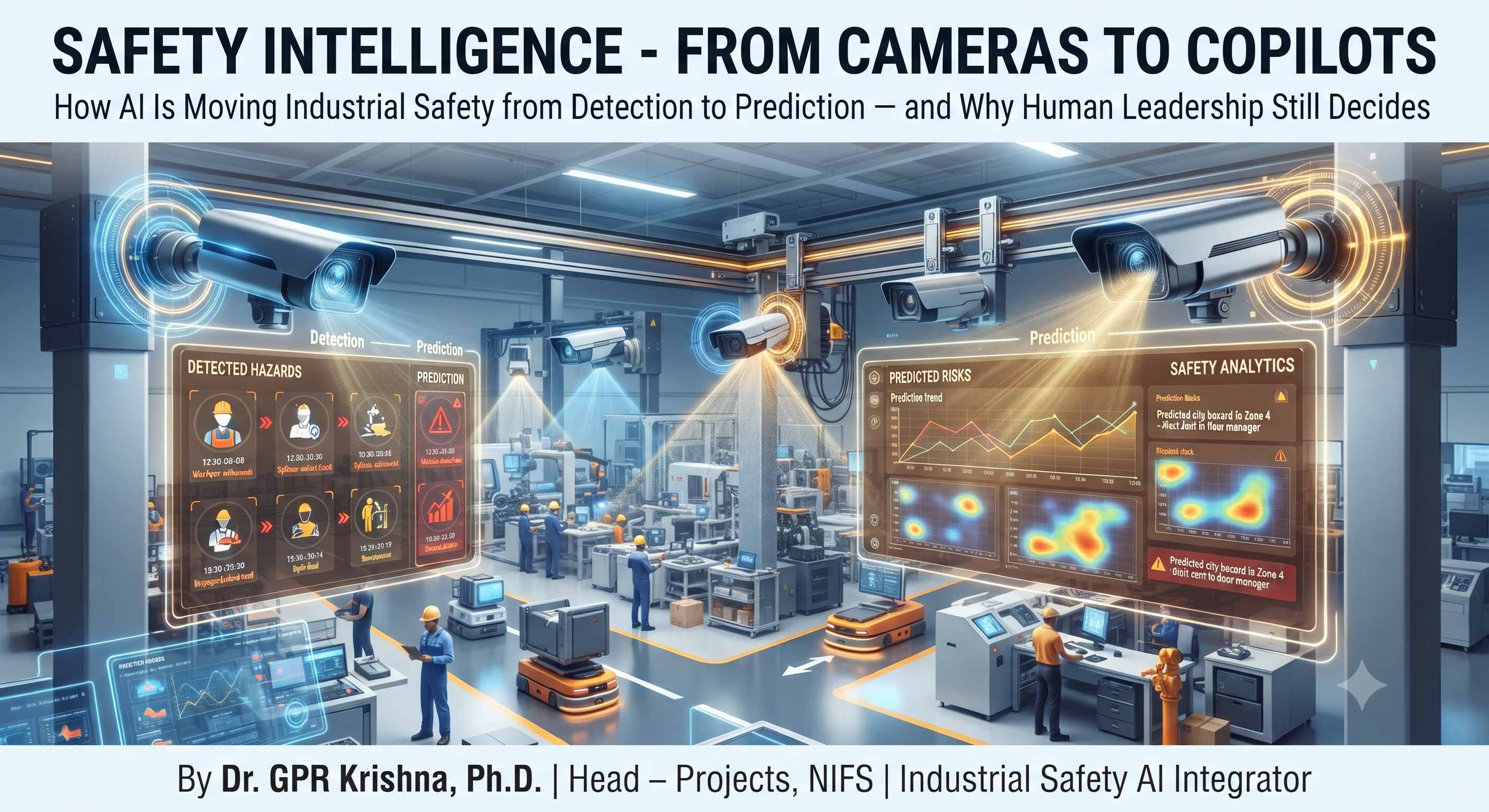
Modern computer vision can support recognition of people, PPE, restricted zones, vehicle movement, unsafe proximity, falls, smoke and flames. But detection is only the first layer.
The real transformation begins when visual information is connected with permits, maintenance records, incidents, contractor information, environmental conditions, process data and behavioural observations.
Camera → Context → Risk → Prediction → Action → Learning
That is the journey from CCTV monitoring to Safety Intelligence.
The question for every Safety Professional is simple: are we going to use AI merely to watch the workplace — or are we going to use it to understand the workplace?
From CCTV to a Safety Copilot
Traditional CCTV answers: "What happened?" AI-enabled vision can begin answering: "What is happening now?"
The next question is: "What is likely to happen next, what deserves attention and what action should follow?"
AI does not become the Safety Officer. It gives the Safety Professional a continuous digital layer of observation.
A human cannot watch hundreds of cameras continuously. AI can identify where attention is needed. The Safety Professional investigates, engages people and drives corrective action.
AI should extend human visibility — not replace human responsibility.
The New Safety Model
| Traditional Safety | Safety Intelligence |
|---|---|
| Inspect → Identify → Report → Correct → Close | Sense → Detect → Understand → Predict → Prioritise → Act → Learn |
| Search for problems | Focus attention on emerging risk |
| Mostly retrospective | Increasingly proactive |
| Activity-driven reporting | Risk-driven decision-making |
| Data in separate systems | Connected safety information |
| Safety department centric | Organisation-wide ownership |
The objective is not to remove conventional safety practice. It is to make that practice more intelligent. Technology can do repetitive observation. People must do judgement, intervention, coaching, engineering and leadership.
What AI Can Actually See
AI-enabled computer vision is not magic. Its performance depends on the model, training data, camera position, lighting, weather, occlusion, PPE, worker posture and the industrial environment.
| Application | AI Can Support |
|---|---|
| PPE | Visible helmet, vest, gloves and other PPE |
| Restricted zones | Entry into predefined hazardous areas |
| Vehicle safety | Vehicle movement and proximity events |
| Pedestrian safety | Person–vehicle interaction |
| Falls | Selected sudden posture or motion changes |
| Fire | Visible smoke or flame patterns |
| Housekeeping | Selected visible obstructions or spills |
| Emergency response | Crowd movement, blocked routes and evacuation patterns |
The key word is support. AI detection is not automatically equivalent to confirmed risk. Critical alerts require validation and a defined human response.
Fewer alerts. Better alerts. Faster decisions.
The best AI safety system will answer these six questions: What happened? Where did it happen? When did it happen? How serious is it? Who needs to know? What happened after the alert?
Without the final question, AI remains an observation system — not a safety management system.
Detection Is Not Prevention
This is one of the most important principles in this discussion.
A camera detects a worker entering a restricted area. AI sends an alert. A supervisor intervenes. The event is investigated. The reason is understood. The procedure or layout is improved. Similar events stop occurring.
Now we have prevention. The intelligence came from the technology. The improvement came from leadership.
Do not measure AI success only by alerts generated. The real measure is risk reduced.
AI + Fire Engineering
Fire protection is a strong application for intelligent visual analytics. AI can support smoke or flame recognition, thermal anomaly monitoring, hot-work observation, combustible accumulation detection, emergency-route monitoring and post-event video analysis.
This can be useful across large halls, warehouses, conveyor systems, waste areas, battery storage locations and outdoor industrial yards.
AI should strengthen engineered fire protection — never become an excuse to weaken it.
AI + Process Safety: A Different Level of Responsibility
Process safety requires greater caution because pressure, temperature, flow, level, composition, corrosion, equipment condition and human actions interact in complex ways.
AI may identify correlations between variables and historical failures. AI can support a safety-critical decision. It should not casually become the safety-critical decision.
A recent major industrial incident also reminds us that hazard information, procedures, risk reassessment and leadership action must remain connected.
When we risk-assess a workplace using AI, we must risk-assess the AI as well. This is a major new competency for Safety Professionals.
The AI Safety Risk Assessment
Before buying technology, ask:
- What safety problem are we actually trying to solve?
- What can the AI observe — and what can it not observe?
- Who verifies, intervenes, escalates, investigates and closes a critical alert?
- What happens if the AI is wrong? What happens if it stops working?
- How will we measure risk reduction rather than system activity?
The starting point should never be "We want AI." The starting point should be "What risk are we trying to reduce?"
The AI Safety Maturity Model
| Stage | Organisation Capability |
|---|---|
| 1 — Passive | Cameras record incidents. |
| 2 — Detecting | AI identifies selected visible hazards. |
| 3 — Connected | AI connects alerts with operational data. |
| 4 — Predictive | Systems identify trends and emerging risk. |
| 5 — Intelligent | People, AI, processes, data and leadership operate as one learning system. |
The goal is not to purchase the most advanced technology. The goal is to move upward in safety maturity.
From Safety Data to Safety Intelligence
Every industrial organisation already produces safety information: inspections, permits, training, near misses, incidents, audits, maintenance, fire alarms, drills, contractor observations, CCTV and sensor readings.
The problem is often not lack of data. The problem is fragmentation. Each signal may appear manageable. Together, these signals may reveal an emerging operational-risk condition.
This is where Safety Intelligence becomes meaningful. Data becomes intelligence only when context changes a decision.
The Executive Safety Dashboard of the Future
Imagine a Plant Head arriving at 8:30 AM and seeing one intelligent safety view instead of ten separate reports:
| Indicator | Example Status |
|---|---|
| Safety Intelligence Score | 82 / 100 |
| Predicted high-risk areas | 3 |
| PPE compliance | 97.8% |
| Contractor risk | Moderate |
| Vehicle–pedestrian risk | High |
| Fire / smoke alerts | 1 |
| Critical permit deviations | 2 |
| Open CAPA | 14 |
| Immediate leadership attention | Warehouse – Bay 4 |
The executive does not need another report. The executive needs to know: "Where should I intervene today?"
But the dashboard must never become the safety culture. A 97% PPE score does not explain the remaining 3%. Is it supervision? PPE availability? Training? Production pressure? Deliberate non-compliance? A flawed procedure?
AI can create the question. Human leadership must find the answer.
The Future Safety Professional
The Safety Professional of the future will spend less time searching through footage and more time interpreting risk. The competency model is expanding:
- Fire Engineering — prevention, detection, protection and response.
- Industrial Safety — hazard identification, risk assessment and controls.
- Process Safety — loss of containment, barriers and change management.
- Occupational Health — exposure, fatigue, heat and ergonomics.
- Technology — AI, computer vision, sensors and analytics.
- Leadership — communication, influence, decisions and business understanding.
This is not the end of the Safety Professional. It is the beginning of a more powerful profession.
From Safety Officer to Safety Intelligence Leader
Safety Officer → Safety Engineer → Safety Manager → Safety Leader → Digital Safety Leader → Safety Intelligence Leader
The final stage is not defined by knowing the most technology. It is defined by combining People + Process + Technology + Data + Leadership to prevent harm.
The Safety Intelligence Cycle
See → Understand → Predict → Act → Learn
- See — capture information from cameras, sensors, people and systems.
- Understand — convert raw information into meaningful context.
- Predict — identify emerging risk patterns.
- Act — intervene before the risk becomes an incident.
- Learn — use the outcome to improve the system.
Then the cycle begins again. Safety Intelligence is not a software feature. It is a continuous management cycle that converts information into prevention.
The 2035 Factory
Imagine a worker approaching a hazardous zone. The system recognises the location, verifies PPE and generates a warning. The supervisor acts. The event is recorded. The worker corrects the behaviour.
The system notices similar events during shift change. Management investigates. The layout is changed. The problem disappears.
No injury occurs. No lost-time case is recorded. No investigation is required. Nobody celebrates.
And that is exactly the point. The greatest safety success is often the incident that never happens.
What Should Safety Leaders Do This Week?
Do not wait for a five-year digital transformation programme. Start with five questions:
- What are our three most repetitive safety problems?
- Which of them can technology help us observe continuously?
- Which existing data sources can we responsibly connect?
- What human decision must follow every critical alert?
- How will we measure prevention rather than activity?
If your organisation can answer these five questions, the journey has already started. AI is an intelligent support system. It is not a replacement for competent safety leadership.
My Message to Every Safety Professional
Do not fear Artificial Intelligence. Understand it.
Do not blindly trust Artificial Intelligence. Challenge it.
Do not allow technology to replace human judgement. Use technology to strengthen it.
Do not measure digital transformation by the number of cameras installed. Measure it by the risks prevented.
Do not ask, "How advanced is our AI?" Ask, "How much safer has our organisation become because of it?"
Final Thought
The industrial world is entering a new era. The camera becomes a sensor. Data becomes intelligence. Intelligence becomes prediction. Prediction becomes action. And action, supported by strong leadership, becomes prevention.
But there is one thing Artificial Intelligence cannot replace: human responsibility. A machine can detect. A model can predict. A dashboard can prioritise. But someone must decide, intervene, redesign the process, challenge the unsafe condition and stand beside the worker.
"We will not wait for an accident to prove that this risk was real."
That person is the Safety Leader. The future of industrial safety is not AI versus people. It is AI + People + Leadership. The objective is to create workplaces where intelligent systems help people go home safely. Every day.
Call to Action
If your organisation is still using CCTV primarily as a recording system, ask: "Can that infrastructure become more valuable?"
If your Safety Team spends hours searching through footage, ask: "Can AI help focus attention on the highest-risk events?"
If your organisation has thousands of observations but no clear picture of emerging risk, ask: "Can those data streams be responsibly connected?"
Start small. Choose one problem. Measure it. Pilot, validate and involve workers. Keep human judgement at the centre. Then scale what works.
The future will belong to organisations that turn safety data into better decisions.
About the Author
Dr. GPR Krishna, Ph.D. is a Fire and Industrial Safety Professional with more than two decades of experience. As Head – Projects, NIFS and an Industrial Safety AI Integrator, he works at the intersection of safety, technology and intelligent risk management. His focus is helping industries move beyond compliance towards proactive, data-driven and technology-enabled safety systems.
Companies Currently Hiring Through NIFS
CBRE - IT SECTOR
EHS EXECUTIVE
DETECT TECHNOLOGY
SAFETY OFFICER
GAIL (India) Limited
FIRE SAFETY OFFICER
Start Your Career in Industrial Safety Today
NSDC-approved Diploma, Advanced Diploma, and Degree programs with a dedicated placement cell.