Safety Intelligence™: Leading Safety in the Age of Intelligence — The 5D Leadership Model
Want to Build Safety Leadership Skills, Not Just Safety Compliance?
Learn how NIFS builds leadership, technology and business capability into its government-recognized Diploma & ADIS programs. Speak with our Senior Academic Counselors on WhatsApp.
Chat on WhatsApp (+91-8374-340-999)Safety Intelligence™: Leading Safety in the Age of Intelligence
Why Tomorrow's Safety Leaders Will Need More Than Technical Knowledge
Industrial Safety is no longer changing. It is being redefined. For decades, the role of a Safety Professional was clearly understood: conduct inspections, enforce compliance, investigate incidents, maintain records and ensure statutory requirements are fulfilled. Those responsibilities remain essential. But they are no longer sufficient.
Today's industries are more connected, more automated and more data-driven. Artificial Intelligence, predictive analytics, digital twins, smart sensors and intelligent surveillance are changing how organisations identify and manage risk.
The question is no longer whether technology will change industrial safety. It already has. Will Safety Professionals evolve fast enough to lead this transformation?
This edition explores why tomorrow’s Safety Leaders must think beyond regulations and become strategic business leaders who influence decisions, shape culture and create measurable value.
The Boardroom That Changed Everything
Monday. 8:30 AM. The monthly leadership meeting begins. Production reports improved efficiency. Finance reports reduced operating costs. Maintenance reports equipment availability. Then the Safety Manager presents the familiar slide: LTIFR, first aid cases, near misses and training hours.
Now imagine a different Safety Leader:
"Our Predictive Risk Index has increased by 14% over the past three weeks. AI has identified repeated unsafe behaviour in Assembly Line 2. If we do not intervene this week, production continuity may be affected."
The Managing Director asks questions. Operations becomes interested. Finance wants to understand the business impact. Production requests immediate action. The meeting changed because the safety conversation changed.
Are you attending leadership meetings to present safety statistics, or to influence business decisions? That answer defines the difference between a Safety Officer and a Safety Leader.
The Industrial Shift
Factories are becoming intelligent. Machines communicate. Production systems predict failures. Warehouses use autonomous vehicles. Artificial Intelligence analyses large volumes of operational information.
Yet many Safety Professionals continue to depend heavily on clipboard inspections, manual reports, reactive investigations and traditional compliance systems. None of these are wrong. They remain necessary. But tomorrow’s Safety Leaders must add another layer: technology awareness, business understanding, human behaviour and leadership.
Technology can identify risk. Leadership inspires action.
The 5D Safety Leadership Model™
An Original Safety Intelligence™ Framework by Dr. GPR Krishna
Every profession reaches a stage where technical competence alone is no longer enough. Manufacturing progressed from manual operations to smart factories. Maintenance progressed from reactive repairs to predictive maintenance. Industrial Safety is now progressing from compliance to leadership.
The Safety Professional of tomorrow must therefore master five dimensions: Detect, Decide, Develop, Drive and Deliver.
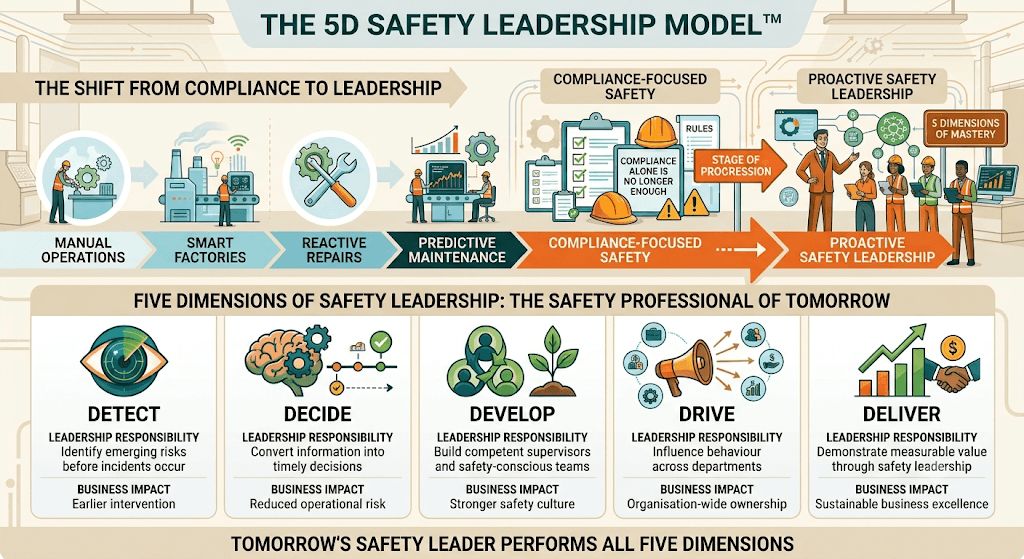
| Dimension | Leadership Responsibility | Business Impact |
|---|---|---|
| Detect | Identify emerging risks before incidents occur. | Earlier intervention |
| Decide | Convert information into timely decisions. | Reduced operational risk |
| Develop | Build competent supervisors and safety-conscious teams. | Stronger safety culture |
| Drive | Influence behaviour across departments. | Organisation-wide ownership |
| Deliver | Demonstrate measurable value through safety leadership. | Sustainable business excellence |
Every Safety Professional performs some of these responsibilities. Tomorrow’s Safety Leader performs all five.
Dimension 1 — Detect
Leadership begins with awareness before the accident develops. A supervisor notices repeated shortcut behaviour. A Safety Professional sees increasing housekeeping deviations. An AI system identifies a rise in forklift speeding. Individually, these observations may look ordinary. Together, they can reveal an emerging risk pattern.
Detection therefore means more than finding unsafe acts. It means recognising weak signals, understanding their frequency and identifying where separate observations may be connected.
- Look for repetition rather than isolated events.
- Track changes in behaviour, equipment condition and work practices.
- Combine frontline observations with digital information.
- Escalate patterns before they become incidents.
The best Safety Leaders notice what others overlook.
Dimension 2 — Decide
Information has no value until it changes a decision. Organisations collect inspection reports, audit observations, near misses, permit deviations and behavioural observations. The challenge is deciding what requires immediate leadership attention.
A mature Safety Leader does not allow important information to disappear into a report. The leader prioritises, assigns ownership, sets timelines and verifies whether the decision produced the intended result.
Reporting describes the condition. Decision-making changes the condition.
Dimension 3 — Develop
A Safety Leader cannot personally be present everywhere. Leadership therefore becomes sustainable only when capability is developed in others. The objective is to create supervisors who recognise hazards, managers who accept accountability, employees who speak up and contractors who understand their responsibility.
Training should therefore move beyond annual programmes. Learning must be reinforced through daily conversations, coaching, toolbox interactions, leadership behaviour and practical decision-making.
"Our supervisors now identify risks before your Safety Officers reach the location."
That is the point at which safety moves beyond one department and becomes organisational behaviour.
Dimension 4 — Drive
Rules can establish compliance. Leadership creates commitment. People observe leaders when production pressure increases. They notice what happens when a deadline is tight, when a critical machine is down or when a safety control delays production.
Every decision sends a message. If leaders compromise a critical control for production, employees learn that production wins. If leaders protect the control while finding a safe way to recover the schedule, employees learn that safety and performance can coexist.
People rarely follow procedures because they are written. They follow them because leaders demonstrate their importance.
Dimension 5 — Deliver
The future Safety Leader will increasingly be expected to demonstrate business value. Safety can contribute to productivity, employee confidence, operational continuity, asset protection, reputation and resilience. The Safety Leader must therefore learn to communicate in the language of business.
Instead of saying only, ‘We reduced incidents,’ the conversation should also explain how safety improved equipment availability, reduced disruption, protected people, strengthened contractor performance or supported business continuity.
Senior leadership invests in organisational performance. The Safety Leader must show how safety contributes to that performance.
Safety Officer or Safety Leader?
| Traditional Safety Officer | Future Safety Leader |
|---|---|
| Conducts inspections | Influences organisational decisions |
| Reports observations | Solves business problems |
| Investigates accidents | Predicts organisational risk |
| Ensures compliance | Builds organisational culture |
| Works within the Safety Department | Works across every department |
| Focuses on regulations | Focuses on organisational excellence |
| Measures incidents | Measures leading indicators |
| Supports management | Advises leadership |
Neither role is wrong. One represents the traditional foundation. The other represents the direction in which the profession must evolve.
The Leadership Maturity Model™
How Safety Professionals Evolve Into Organisational Leaders
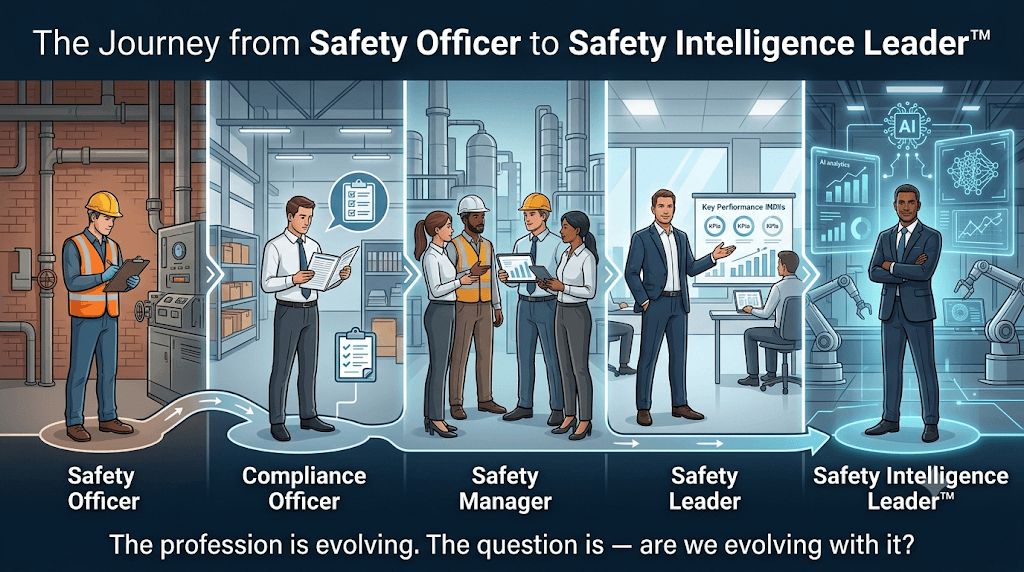
| Stage | Primary Focus | Leadership Behaviour |
|---|---|---|
| Stage 1 — Inspector | Identifies unsafe acts and conditions. | Finds deviations |
| Stage 2 — Compliance Officer | Ensures legal and organisational compliance. | Enforces standards |
| Stage 3 — Safety Manager | Coordinates systems, audits and performance. | Manages programmes |
| Stage 4 — Safety Leader | Influences people, departments and decisions. | Builds organisational culture |
| Stage 5 — Safety Intelligence Leader™ | Uses leadership, data and technology to predict and prevent organisational risk. | Shapes the future of industrial safety |
If you resigned tomorrow, would your organisation miss your reports — or your leadership? That answer reveals your true value.
The New Competencies of a Safety Leader
The next generation of Safety Leaders will require capabilities beyond traditional safety management.
- Business Understanding — Understand production, finance and operational priorities. Connect safety with business performance.
- Communication — Present confidently in boardrooms. Simplify technical concepts. Influence senior management. Inspire frontline workers.
- Technology Awareness — Understand Artificial Intelligence, predictive analytics, digital dashboards, computer vision and Industrial IoT. Not to become software engineers, but to become informed leaders.
- Emotional Intelligence — Listen before advising. Coach before correcting. Influence before enforcing. Respect before expecting respect.
- Strategic Thinking — Ask how every major safety decision can improve organisational resilience and performance.
CEO's Safety Leadership Checklist
Every CEO should ask these questions before concluding that safety is performing well:
- Does our Safety Leader influence executive decisions?
- Are safety discussions connected to business performance?
- Are leading indicators reviewed regularly?
- Are supervisors empowered to make safe decisions?
- Is technology supporting safety leadership?
- Are contractors treated as safety partners?
- Are employees comfortable reporting weak signals?
- Is safety recognised as a competitive advantage?
- Are future Safety Leaders being developed?
- Is our safety culture improving every year?
A Message to Every Safety Professional
The future does not belong to the person who conducts the most inspections. It does not belong to the person who writes the longest reports. It does not even belong to the person who knows every regulation by memory.
The future belongs to the professional who can inspire people, influence leadership, integrate technology with human values and transform safety into organisational excellence.
The journey begins when we stop asking, "What happened?" and start asking, "What future can we create?"
Call to Action
Take this framework into your next safety meeting. Present the 5D model to your leadership team. Ask where your organisation stands today and where it needs to be tomorrow.
- Which dimension is strongest?
- Which dimension is weakest?
- What capability must be developed first?
- What decision can leadership take this month?
Every transformation begins with one conversation that challenges the existing way of working.
Final Thought
When history looks back at this decade, it may not remember every technology that emerged. It may not remember every software platform that was launched. It will remember the leaders who had the courage to rethink safety.
The greatest contribution of a Safety Leader is not simply reducing accident numbers. It is creating an organisation where people instinctively choose the safe way because leadership has made safety part of the organisational DNA.
The factories of tomorrow will not be defined by smarter machines alone. They will be defined by smarter leaders who use technology to protect people, strengthen organisations and inspire a culture where safety becomes everyone’s responsibility.
Author: Dr. GPR Krishna, Ph.D. — GM Projects, IFESM, NIFS
Advance Your Career with NIFS Safety Intelligence™ Programs
Explore NIFS government-recognized and NSDC-approved safety engineering programs across 70+ centers in India.
Companies Currently Hiring Through NIFS
NIFS/IFESM
SAFETY PROFESSIONAL
ROBOMATIC PRECON PVT LTD
SAFETY OFFICER
Beekay Steel Industries Ltd
Safety Officer
Frequently Asked Questions
What is the 5D Safety Leadership Model?
A framework describing five leadership dimensions Safety Professionals must master to move from compliance to organisational leadership: Detect, Decide, Develop, Drive and Deliver.
Are NIFS Fire and Safety programs NSDC and university recognized?
Yes, NIFS courses are NSDC-approved, recognized by PSU, private industrial employers, and overseas firms in Gulf countries.
Does NIFS provide placement assistance after course completion?
Yes, NIFS has a dedicated placement cell and 45,000+ alumni.
Start Your Career in Industrial Safety Today
NSDC-approved Diploma, Advanced Diploma, and Degree programs with a dedicated placement cell.