NEBOSH, IOSH vs SBTET ADIS/PDIS: What Every Safety Student in India Must Know Before They Pay
When India is aiming to become one of the world's top economies by 2047, the quiet pain of a genuine safety student is something that concerns me deeply as a Fire and Industrial Safety professional. Young aspirants enter this profession with real dreams — a respectable career, financial stability, a chance to work with global industries. But somewhere along the way, many are taught that collecting certificates is the same as building a safety career. It is not. Before spending hard-earned money on any safety course, a student and their parents must first ask: what is the actual career and statutory value of this qualification in India? That one question can save years of time, money, and disappointment.
From Dr. Krishna's Desk
For more than 14 years, I have been involved in recruiting, evaluating, and deploying Fire and Industrial Safety professionals for Indian industries. I have met hundreds of young professionals — some with one certificate, some with five, some with ten. Some have completed NEBOSH, IOSH, and other international HSE certifications, and their files look impressive. But when I ask, “What is your primary safety qualification?”, the conversation sometimes turns uncomfortable.
I have spoken with professionals who spent lakhs of rupees on international certifications and other expensive courses — some borrowed money, some used their parents' savings. They believed they had completed the course; in reality, they had completed the procedure. They returned to industry expecting elevation. The certificate was there. The money was gone. The expected opportunity was still awaited. Honestly, that pains me. My concern is not against international certifications — it is that students and parents deserve the complete picture before they pay.
The Certificate Trap
The problem is not that certificates exist. The problem begins when a student starts believing that Certificate = Qualification = Job = Career = Luxury. Years in this field teach us these are not automatically the same thing. A certificate may demonstrate completion of a programme. A recognised qualification builds a professional foundation. Employment depends on qualification, competence, experience, and the employer's requirements — and a statutory appointment may carry additional legal requirements on top of all of that. Ask where a qualification actually fits into the career you want, before you pay for it.
The Foundation: Education Before Certificates
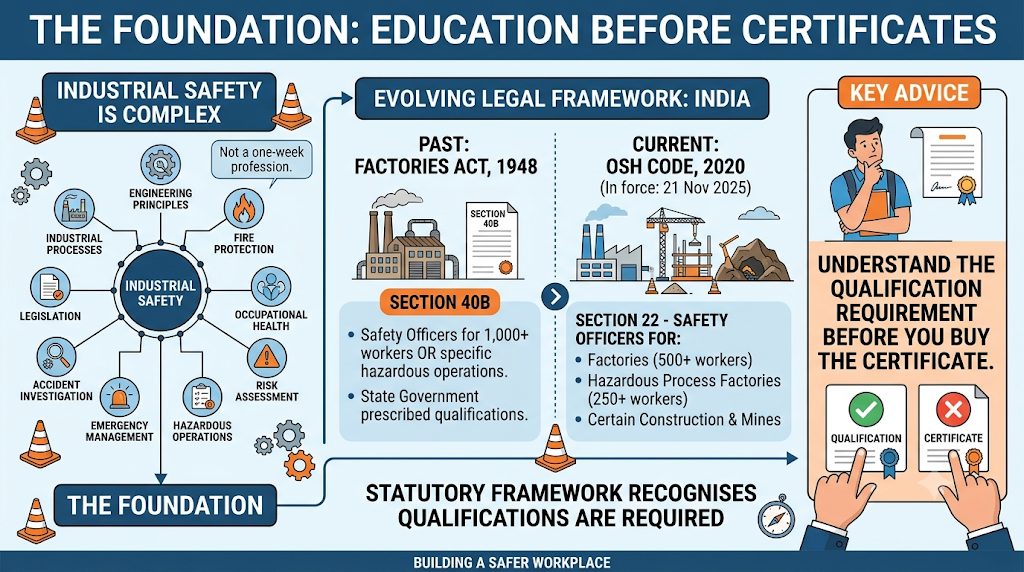
Industrial Safety is not a one-week or one-month profession. It involves engineering principles, industrial processes, fire protection, occupational health, hazardous operations, risk assessment, emergency management, accident investigation, legislation, and human behaviour. India has had a statutory framework for Safety Officers for decades. Under the Factories Act, 1948, Section 40B specifically dealt with Safety Officers — providing for their appointment in factories employing 1,000 or more workers, or in factories involving specified hazardous operations where the State Government required it, with duties, qualifications, and conditions of service prescribed by the State Government.
That legal framework has since evolved. The Occupational Safety, Health and Working Conditions Code, 2020 came into force on 21 November 2025. Section 22 provides for Safety Officers in specified establishments — including factories with 500 or more workers, hazardous-process factories with 250 or more workers, certain construction establishments, and mines — with qualifications and duties prescribed by the appropriate Government. The statutory framework itself recognises that Safety Officer appointments are linked to prescribed qualifications. So the advice to students stays simple: understand the qualification requirement before you buy the certificate.
What Regulators Actually Say
The Directorate General Factory Advice Service and Labour Institutes (DGFASLI) provides an important benchmark here. Its published information on ADIS, PDIS, and DIS programmes describes these as recognised statutory qualifications under the earlier Factories Act framework, and presents a structured professional education model built on academic learning, practical work, factory exposure, projects, and examination. Look at the difference between the two paths: Payment → Short course → Certificate, versus Education → Practical exposure → Assessment → Qualification. That difference matters, and depending on a student's background and intended role, the safety foundation may include a Diploma in Fire & Industrial Safety, an Advanced Diploma in Industrial Safety (ADIS), a Post Diploma in Industrial Safety (PDIS), a relevant PG Diploma, a DGFASLI-affiliated CLI/RLI statutory diploma, or a university degree in Fire & Industrial Safety — ideally recognised by a UGC-approved university. Build the foundation first.
NEBOSH, IOSH and International Certifications — Know Their Place
Let me be very clear: NEBOSH, IOSH, and other international certifications are not without value. They can provide useful professional knowledge and may support particular MNC or overseas career objectives. The concern is when a young Indian student believes an expensive international certificate automatically becomes the primary qualification for every Safety Officer role in India. The applicable Indian statutory requirement must be checked for the specific role and establishment. In the context of building an industrial safety career in India, these programmes are not primary intake qualifications — they are up-skilling add-on courses for working professionals. Here is the ground reality against the commercial pitch:
| The Myth Promoted by Commercial Centers | The Ground Regulatory Reality in India |
|---|---|
| “NEBOSH makes you a qualified Safety Officer anywhere in India.” | FALSE. Under Indian Factory Rules and the OSH Code, an international certificate is not recognised as a standalone statutory qualification for appointment as a Safety Officer. |
| “Foreign certificates are superior to Indian university degrees.” | FALSE. Indian regulatory authorities require recognised engineering degrees, state-board diplomas, or approved ADIS/PDIS. Foreign certificates without an Indian base are legally invalid on Indian shop floors. |
| “NEBOSH guarantees an instant, high-paying job in the Gulf.” | FALSE. Gulf employers require an accredited primary engineering/science degree plus years of heavy industrial site experience. A fresher with only a certificate is almost never hired for core safety roles. |
| “You should take NEBOSH immediately after school or college.” | FALSE. Taking NEBOSH before earning a recognised Indian safety degree/diploma wastes money. It is an up-skilling tool for working professionals, not a starting point for freshers. |
A Note to Three Kinds of Students
The intermediate student — don't demand an expensive certificate just because a cousin or uncle works abroad. Get proper career counselling first. The graduate or engineer — you already have an academic foundation; identify a one-year safety qualification that is genuinely recognised and accepted by Indian industry, not just any foreign course. The working professional — your industrial experience is valuable and sets a benchmark, but experience alone doesn't automatically satisfy every statutory qualification requirement. A standard, ratified qualification does. One principle covers all three: build the foundation before buying the additions.
We Do Not Have Money for Experiments
A young professional may start on a modest salary. A parent may have saved that money for years. A graduate may already carry an education loan. A working professional may be investing straight from a monthly salary. That money deserves respect. I am strongly for education and for professional development — but I am equally against a student spending large sums on foreign courses, from unauthorised institutes, without first working out what the qualification actually means for their career. When someone tells me, “Sir, I spent so much money, I completed the course, but I am still not getting the job I expected,” I don't blame the student. I feel sorry that the complete information wasn't available before the money was spent. That is exactly the situation this article is meant to prevent, because what industry actually wants is straightforward: an authentic qualification, real experience, the companies worked at, the skills gained, computer knowledge, communication in English and Hindi, audit-level competency, and a real commitment from the candidate.
Protect Yourself — Nobody Else Will Do This For You
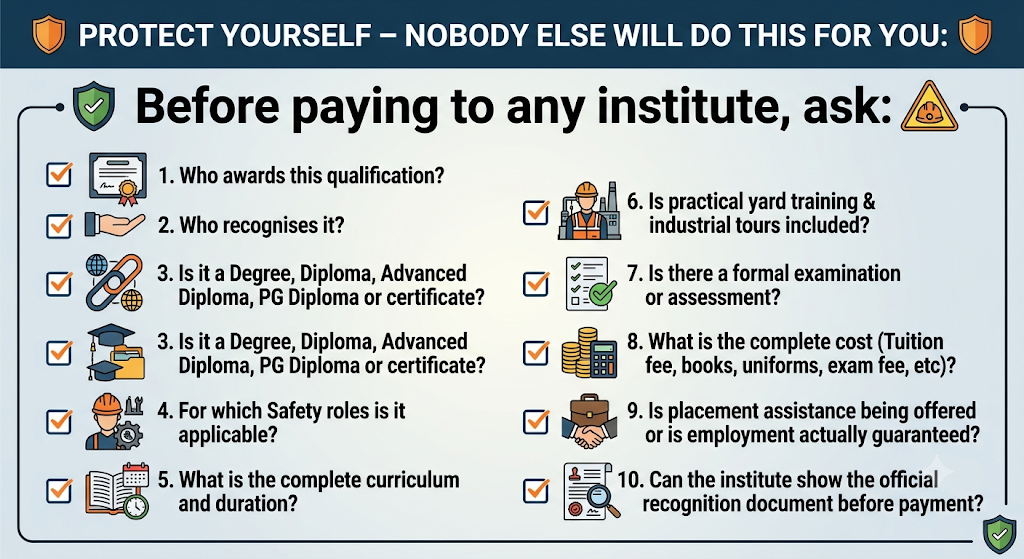
Before paying any institute, ask: Who awards this qualification? Who recognises it? Is it a degree, diploma, advanced diploma, PG diploma, or a certificate? For which safety roles is it applicable? What is the complete curriculum and duration? Is practical yard training and industrial exposure included? Is there a formal examination or assessment? What is the complete cost — tuition, books, uniforms, exam fees? Is placement assistance being offered, or is employment actually guaranteed? And can the institute show the official recognition document before payment? If someone says “complete this course and your job is 100% guaranteed,” ask for it in writing. If someone says “our certificate is equivalent to the statutory qualification,” ask them to show the applicable government notification or rule. Don't argue, don't fight — just verify.
The Question Every Student Should Ask
Before paying ₹50,000, ₹1 lakh, ₹2 lakh or more for any safety programme, stop and ask: “What exactly am I buying?” Education? A recognised qualification? A professional certificate? A specialised skill? An international certification? Or simply a certificate of course completion? There is nothing wrong with paying for quality education — but you must know what you are actually paying for. Your career is too important to be decided by a brochure.
A Message to Every Student
This article is not written to attack any particular institute, and it does not name any organisation — it is not saying every private training provider is misleading students. The concern is simpler than that: students must receive complete and honest information before they spend their money. If a qualification is recognised, explain the recognition. If it is a professional certificate, call it a professional certificate. If it is an additional qualification, explain exactly where it adds value. If placement assistance is offered, explain clearly what that means. And most importantly — never let a student believe that an expensive certificate automatically replaces the recognised qualification required for the safety role they are targeting.
India is an ever-growing country with wide-open opportunities and rising demand for genuinely competent safety professionals. We don't need students competing to collect fancy certificates. We need young people with proper education, recognised qualifications, practical exposure, industrial experience, and professional competence. Additional certifications and specialisation can come later — but the foundation must come first.
Before You Invest

Ask — verify — understand — then decide. Your money matters. Your time matters. Your career matters. Your parents' dreams matter. Please verify before you invest. Build the qualification first. Build the career next.
“A certificate can be printed in one day. A genuine professional career takes years to build, truly. Choose the qualification that builds the career — not the certificate that fills the file.”
NIFS builds exactly this kind of statutory, regulator-recognised foundation for safety careers in India — through programmes like the Diploma in Industrial Safety (DIS) and the Advanced Diploma in Industrial Safety (ADIS), with a Post Diploma in Industrial Safety (PDIS) pathway for working professionals seeking DGFASLI-aligned upskilling. Students and parents evaluating a safety career can start with admissions to ask exactly the questions this article recommends, before paying anyone.
About the author: Dr. GPR Krishna, Ph.D. is a Fire and Industrial Safety professional with more than two decades of experience in Fire Engineering, Industrial Safety, and Occupational Health & Safety. He holds PGDFS and ADIS qualifications and has extensive experience recruiting, developing, and deploying safety professionals across Indian industries. He serves as Head – Projects, NIFS, and works as an Industrial Safety AI Integrator.
References:
- Government of India, India Code — The Factories Act, 1948, Section 40B: Safety Officers.
- Government of India, India Code — Occupational Safety, Health and Working Conditions Code, 2020, Section 22: Safety Committee and Safety Officers.
- Directorate General Factory Advice Service & Labour Institutes (DGFASLI), Ministry of Labour & Employment, Government of India — ADIS/PDIS/DIS Programme and Prospectus.
- Acharya Nagarjuna University — Official Fire & Industrial Safety Programme Information.
Explore More
Companies Currently Hiring Through NIFS
NIFS/IFESM
SAFETY PROFESSIONAL
ROBOMATIC PRECON PVT LTD
SAFETY OFFICER
Beekay Steel Industries Ltd
Safety Officer
Frequently Asked Questions
Is a NEBOSH or IOSH certificate enough to become a Safety Officer in India?
No. Under Indian Factory Rules and the Occupational Safety, Health and Working Conditions Code, 2020, an international certificate like NEBOSH or IOSH is not recognised as a standalone statutory qualification for appointment as a Safety Officer. A recognised Indian qualification such as a diploma, ADIS, PDIS, or an approved engineering degree is required first.
What is the legal basis for Safety Officer qualifications in India?
The Factories Act, 1948, Section 40B originally provided for Safety Officers in larger or hazardous factories, with qualifications prescribed by the State Government. This has evolved into the Occupational Safety, Health and Working Conditions Code, 2020, which came into force on 21 November 2025 — its Section 22 provides for Safety Officers in specified establishments, with qualifications prescribed by the appropriate Government.
When should a student consider NEBOSH or IOSH?
After building a recognised Indian safety foundation — a diploma, ADIS, PDIS, or safety-related engineering degree — and typically once already working. These international certifications work best as an up-skilling add-on for working professionals targeting MNC or overseas roles, not as a first qualification for freshers.
What should a student ask an institute before paying for a safety course?
Who awards and recognises the qualification, whether it is a degree, diploma, advanced diploma, PG diploma or certificate, which safety roles it applies to, the full curriculum and duration, whether practical yard training is included, whether there is a formal exam, the complete cost, and whether the institute can show the official recognition document before any payment is made.
ADIS or PDIS — which is better for a safety career in India?
Neither is universally "better" — they suit different starting points. ADIS (Advanced Diploma in Industrial Safety) is typically taken after Class 12 or a diploma as a full foundational safety qualification. PDIS (Post Diploma in Industrial Safety) is designed for candidates who already hold a diploma, degree, or relevant work experience and want a faster, more advanced route into a Safety Officer role. Both are DGFASLI-aligned statutory-style qualifications, unlike NEBOSH or IOSH, which are international add-on certifications rather than a substitute for either.
Start Your Career in Industrial Safety Today
NSDC-approved Diploma, Advanced Diploma, and Degree programs with a dedicated placement cell.