Integrated Safety Management System (ISMS) Explained by NIFS HSE Head Dr. Gaddeyya Gandipilli
An Integrated Safety Management System (ISMS) is a comprehensive framework that combines an organization's safety regulations, policies, and procedures into a single system. This integrated strategy strives to streamline safety management, improve regulatory compliance, minimize accidents, increase efficiency, and promote improved safety communication across departments.
An ISMS typically includes safety compliance monitoring, hazard identification and risk assessment, operational controls, emergency planning, training, and ongoing monitoring and review. Finally, an ISMS encourages a proactive and holistic approach to workplace safety, with active participation of workers to promote a genuine safety culture.
Introduction
The Integrated Safety Management System (ISMS) is a systematic, comprehensive, and technology-driven method for improving worker safety in a variety of hazardous sectors. The purpose of ISMS is to create an accident-free workplace and to develop a safety culture among management, employees, and the general public in order to protect both the workplace and the environment.
ISMS relies on the standards of international safety institutions and organizations such as OSHA, NFPA, ILO, ISO, WHO, UNEP, NIOSH, DGFASLI, and BIS. It is also widely built on established frameworks including Integrated Management Systems (ISM), Quality Management Systems (QMS), Environmental Management Systems (EMS), and Occupational Health and Safety Management Systems (OHSAS).
Definition
The Integrated Safety Management System (ISMS) is a complete framework that combines all safety regulations, rules, standard operating procedures, and processes into a single system. This strategy ensures that all safety-related activities — from identifying industrial hazards to enforcing compliance regulations — are managed in a streamlined and efficient manner. Integrating diverse safety aspects reduces the gaps, overlaps, and inefficiencies that can occur when using disparate, disconnected safety management systems.
Objectives of an Integrated Safety Management System
- Prevent accidents, injuries, and occupational diseases
- Identify hazards and reduce workplace risks
- Protect workers, contractors, visitors, property, and the environment
- Ensure industry-specific legal and regulatory compliance
- Improve emergency preparedness and response
- Develop worker competency through training and awareness
- Strengthen safety culture and worker participation
- Monitor safety performance through inspections, audits, and indicators
- Investigate incidents and eliminate root causes
- Promote continual improvement in safety and health performance
Salient Features
An effective Integrated Safety Management System moves beyond a checklist-based safety culture toward a proactive, genuinely integrated approach — a structured system with real regulatory compliance built in, not just paperwork completed after the fact. It comprises risk management, quality assurance, environmental protection, and occupational safety working together, with the objective of performing work in a safe and environmentally sound manner, increasingly supported by AI-sensor-based safety systems.
Technology-Based ISMS and Its Components
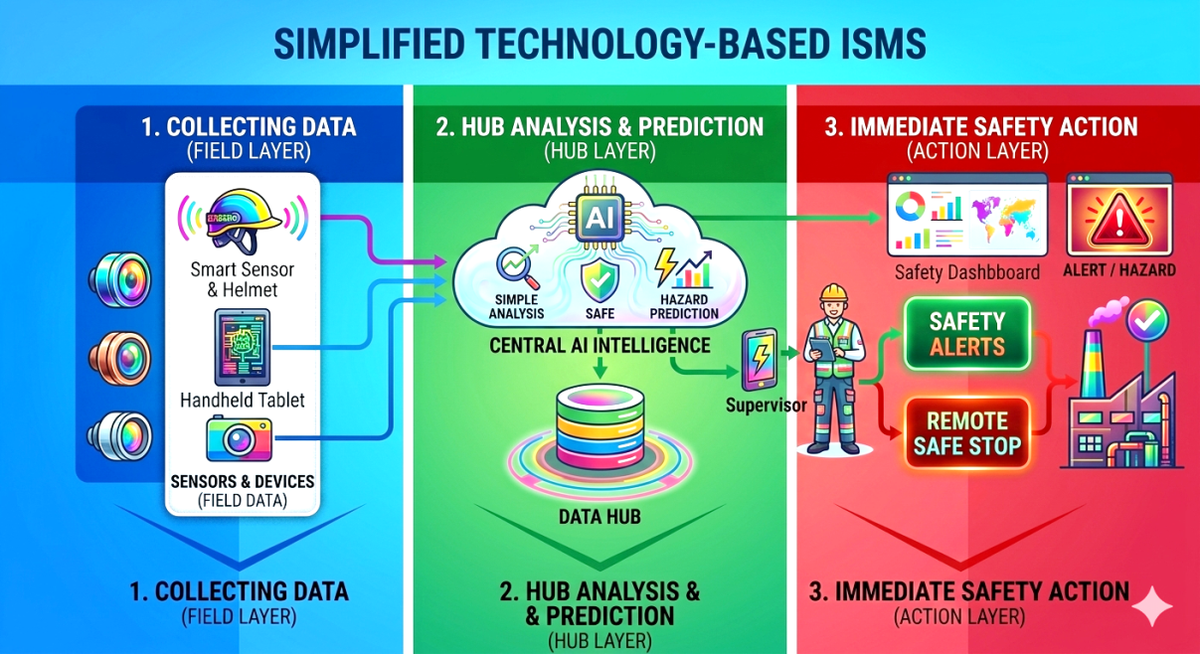
Modern ISMS implementations increasingly layer real-time technology on top of the traditional safety framework: field-level sensors and smart wearables collecting data, a central hub analyzing it and predicting hazards, and an action layer that turns that analysis into immediate safety alerts, dashboards, and even remote safe-stop capability at the plant level.
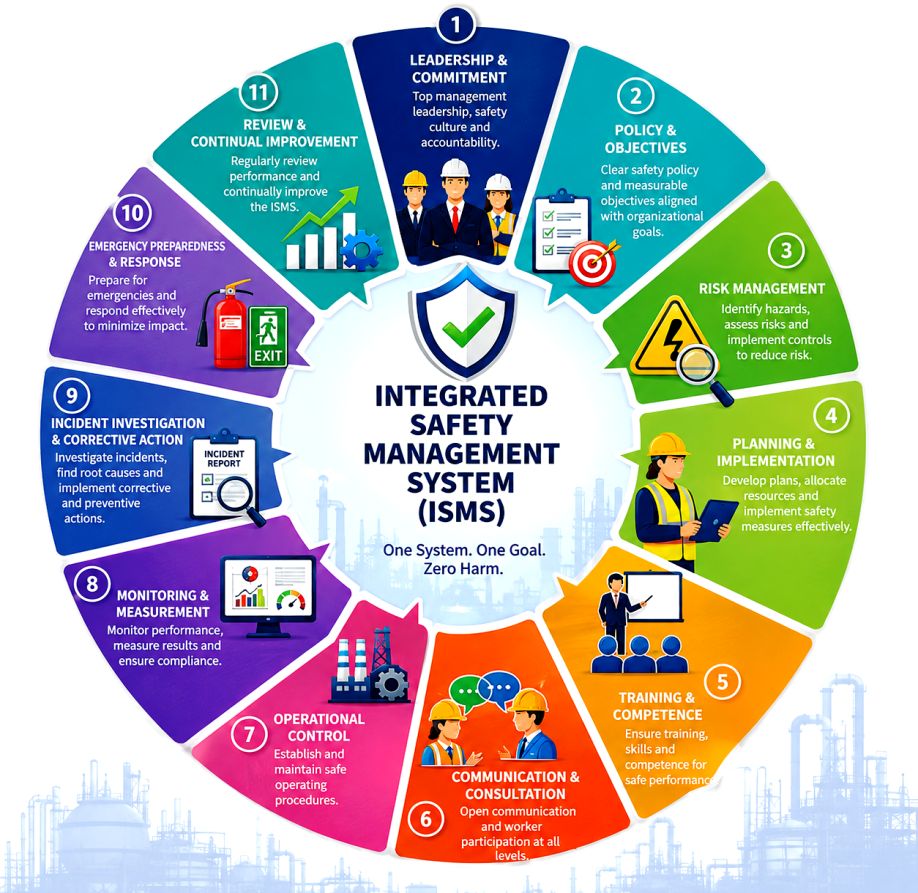
Core Components of ISMS
- Committed leadership
- Safety policy, occupational health, and environment
- Hazard identification & risk assessment (HIRA)
- Safety planning & implementation
- Training & competence building
- Effective communication & worker participation
- Operational safety controls
- Monitoring & performance measurement
- Incident investigation & corrective action
- Emergency preparedness & response
- Management review & continual improvement
Benefits of an Integrated Safety Management System
- Identifies hazards and implements effective control measures to prevent accidents, injuries, and occupational illnesses
- Minimizes exposure to physical, chemical, biological, ergonomic, and psychosocial hazards in the workplace
- Conducts systematic hazard identification, risk assessment, and implementation of the hierarchy of controls
- Encourages safe behavior and employee responsibility
- Provides appropriate induction, job-specific training, and emergency response training
- Ensures safe equipment, machinery, and workplace conditions
- Implements health surveillance and preventive measures for occupational health risks
- Identifies root causes of accidents and near-misses and implements corrective and preventive actions
- Ensures workers are prepared to respond effectively to fires, explosions, chemical releases, medical emergencies, and other incidents
- Meets applicable occupational health, safety, environmental, and statutory requirements
NIFS's own diploma and certificate programs are built around this same 70/30 practical-to-classroom model that a real ISMS depends on — competent, field-ready people are what actually make any safety management system work day to day, not the framework document alone.
Conclusion
A comprehensive ISMS program meets the contemporary challenges of hazardous industries and helps ensure worker safety, machine safety, and occupational health and environmental protection. National and international standards, key legislation, and occupational safety and health regulations are enforced and monitored far more effectively with a properly implemented ISMS in place.
References
- Occupational Health and Safety Management Systems — A Practical Guide
- Industrial Safety and Health Management — C. Ray Asfahl & David W. Rieske
- ISO 45001:2018 — Occupational Health and Safety Management Systems: Requirements with Guidance for Use
- ISO 31000:2018 — Risk Management: Guidelines
- Occupational Safety, Health and Working Conditions Code, 2020
- National Disaster Management Authority (NDMA) guidelines
About the author: Dr. Gaddeyya Gandipilli is Head of the Department (HSE) at NIFS, Headquarters, Visakhapatnam. The author sincerely thanks the management of NIFS for their consistent support and encouragement in preparing this article.
Companies Currently Hiring Through NIFS
NIFS/IFESM
SAFETY PROFESSIONAL
ROBOMATIC PRECON PVT LTD
SAFETY OFFICER
Beekay Steel Industries Ltd
Safety Officer
Frequently Asked Questions
What is an Integrated Safety Management System (ISMS)?
An ISMS is a comprehensive framework that combines an organization's safety regulations, policies, and procedures into a single system, covering hazard identification, risk assessment, operational controls, emergency planning, training, and ongoing monitoring and review.
What are the core components of ISMS?
Committed leadership, safety policy, hazard identification & risk assessment (HIRA), safety planning & implementation, training & competence building, communication & worker participation, operational safety controls, monitoring & performance measurement, incident investigation, emergency preparedness & response, and management review & continual improvement.
Which international standards does ISMS rely on?
ISMS draws on standards from OSHA, NFPA, ILO, ISO (including ISO 45001:2018 and ISO 31000:2018), WHO, UNEP, NIOSH, DGFASLI, and BIS, alongside frameworks like Quality Management Systems (QMS) and Environmental Management Systems (EMS).
How does technology support a modern ISMS?
Field-level sensors and smart wearables collect real-time safety data, a central AI hub analyzes it and predicts hazards, and an action layer turns that analysis into immediate safety alerts, dashboards, and remote safe-stop capability.
Start Your Career in Industrial Safety Today
NSDC-approved Diploma, Advanced Diploma, and Degree programs with a dedicated placement cell.