Types of Fire Extinguishers, Classes of Fire & How to Use
Portable fire extinguishers fall into five primary types in India: Water (Class A solid combustibles), Foam (Class A and B flammable liquids), Dry Powder (Class A, B, and C gas fires), Carbon Dioxide (flammable liquids and live electrical risks), and Wet Chemical (Class F cooking oils). To operate any standard fire extinguisher, use the 4-step PASS technique: Pull the safety pin, Aim the nozzle at the base of the fire, Squeeze the operating lever, and Sweep side to side until extinguished.
Selecting the correct fire extinguisher requires understanding the fuel source powering the flames. In India, fire extinguisher manufacturing, testing, and performance are governed by the Bureau of Indian Standards (BIS) through IS 15683:2018, while selection, installation, and maintenance follow IS 2190:2024, alongside Part 4 of the National Building Code of India (NBC 2016). Using an unsuitable extinguisher—such as discharging water onto burning cooking oil or live electrical equipment—can cause dangerous splash flare-ups or fatal electrocution. This guide outlines official fire classifications, cylinder requirements, operational steps, maintenance guidelines, and practical safety rules.
What are the types of fire extinguishers?
Portable fire extinguishers are categorised by the extinguishing agent stored within the cylinder. Under Indian Standard IS 15683:2018, each agent tackles specific combustion mechanisms through cooling, smothering, starving, or chemically interrupting the chain reaction:
- Water Extinguishers (Water Jet and Water Spray): Discharges a high-velocity stream or fine spray of water. Operates through rapid cooling by absorbing thermal energy and reducing the fuel temperature below its ignition threshold. Best for solid organic materials like wood, paper, and textiles. Never use water on electrical hazards or liquid fires.
- Mechanical Foam Extinguishers (AFFF - Aqueous Film Forming Foam): Discharges an aqueous solution blended with foaming agents. The foam floats across the surface of liquid fuel, creating a vapour-sealing blanket that starves the fire of oxygen and prevents re-ignition while cooling adjacent surfaces. Suitable for organic solids and flammable liquids like petrol and diesel.
- Dry Chemical Powder Extinguishers (ABC and BC Stored Pressure): Multi-purpose extinguishers containing chemical powders like monoammonium phosphate (ABC) or sodium and potassium bicarbonate (BC). The powder melts upon contact with heat, coating combustible surfaces to block oxygen while chemical radicals interrupt flame propagation. ABC powder is non-conductive and certified for live electrical risks when indicated on the label.
- Carbon Dioxide (CO2) Extinguishers: Discharges liquefied carbon dioxide through a non-conductive discharge horn as a cold gas and snow. CO2 displaces oxygen, suffocating the flames while exerting a rapid cooling effect. Because it leaves zero chemical residue, it is the primary choice for electrical control rooms, switchboards, computer servers, and scientific instruments.
- Wet Chemical Extinguishers: Formulated with alkaline salts such as potassium acetate or potassium citrate specifically for kitchen fat fires. When discharged, the mist reacts with hot cooking oil through saponification, forming a thick, soapy, non-combustible foam blanket that seals the liquid surface, suppresses vapours, and cools the oil below flash point.
- Clean Agent Extinguishers: Discharges non-conductive, zero-ozone-depletion halocarbon or inert gas blends. They extinguish fires primarily by heat absorption without leaving corrosive residue or damaging delicate electronics, making them ideal for high-tech communication rooms and server racks.
What are the classes of fire?
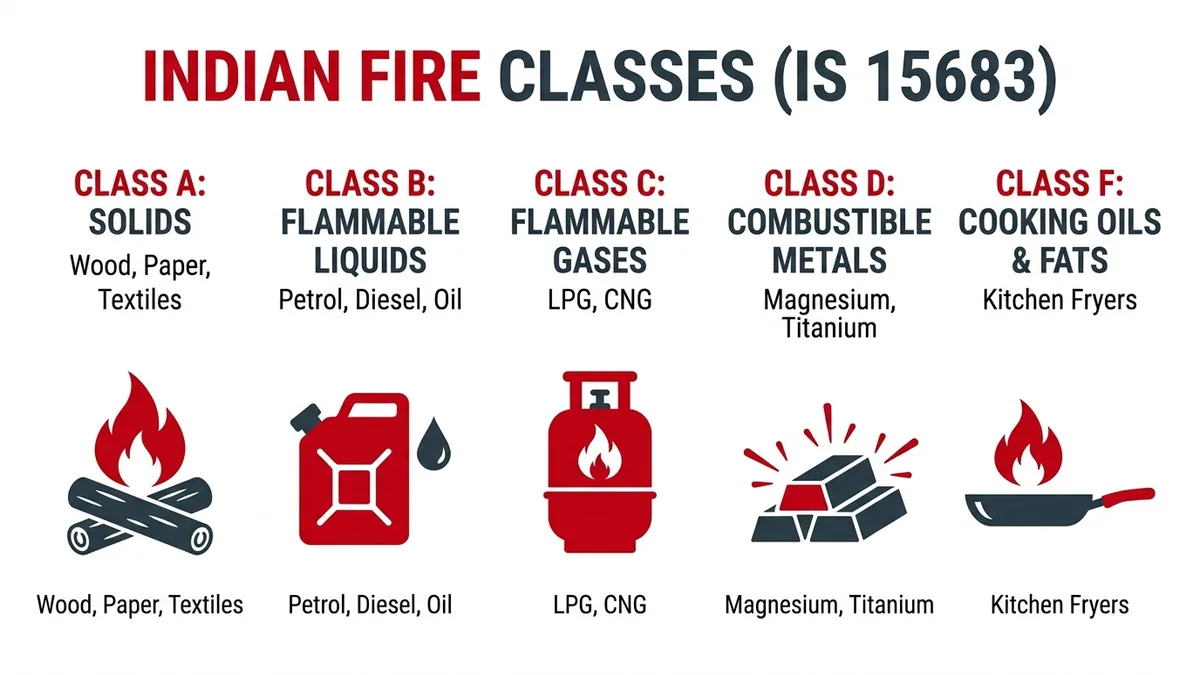
India follows the classification of fires established by the Bureau of Indian Standards under IS 15683:2018 and IS 2190:2024, which classifies fires into Class A, B, C, D, and F based on fuel characteristics. Understanding these categories is essential because Indian fire classifications differ notably from United States standards (NFPA 10):
- Class A (Solid Combustibles): Fires involving carbon-based solid combustible materials of an organic nature, such as timber, paper, cardboard, fabrics, plastics, and coal, where burning normally forms glowing embers.
- Class B (Flammable Liquids): Fires involving flammable liquids or liquefiable solids, such as petrol, diesel, kerosene, industrial solvents, paints, lubricants, and tar.
- Class C (Flammable Gases): Under Indian Standards (IS 15683 / IS 2190), Class C specifically designates fires involving flammable gases under pressure, such as Liquefied Petroleum Gas (LPG), Compressed Natural Gas (CNG), methane, propane, butane, and acetylene. (Note: In the US NFPA system, Class C designates electrical fires. In India, Class C strictly means flammable gases).
- Class D (Combustible Metals): Fires involving combustible metals such as magnesium, aluminium shavings, titanium, sodium, and potassium. These fires burn at extreme temperatures and react violently with water, requiring specialized Class D dry powder agents that smother without exothermic reactions.
- Class F (Cooking Media): Fires involving commercial and domestic cooking oils, vegetable fats, and animal greases in cooking appliances like deep fat fryers. (Note: In the US NFPA system, cooking fires are designated as Class K).
- Electrical Hazards (Energized Equipment): Under IS 15683:2018 and IS 2190:2024, electricity is classified as an ignition risk rather than an independent fuel class. Electrical is not a separate class in India; only use an extinguisher on live electrical equipment if its label says it is safe for electrical fires. Once the power supply is isolated, the fire is treated according to the underlying fuel source.
Which extinguisher for which fire?
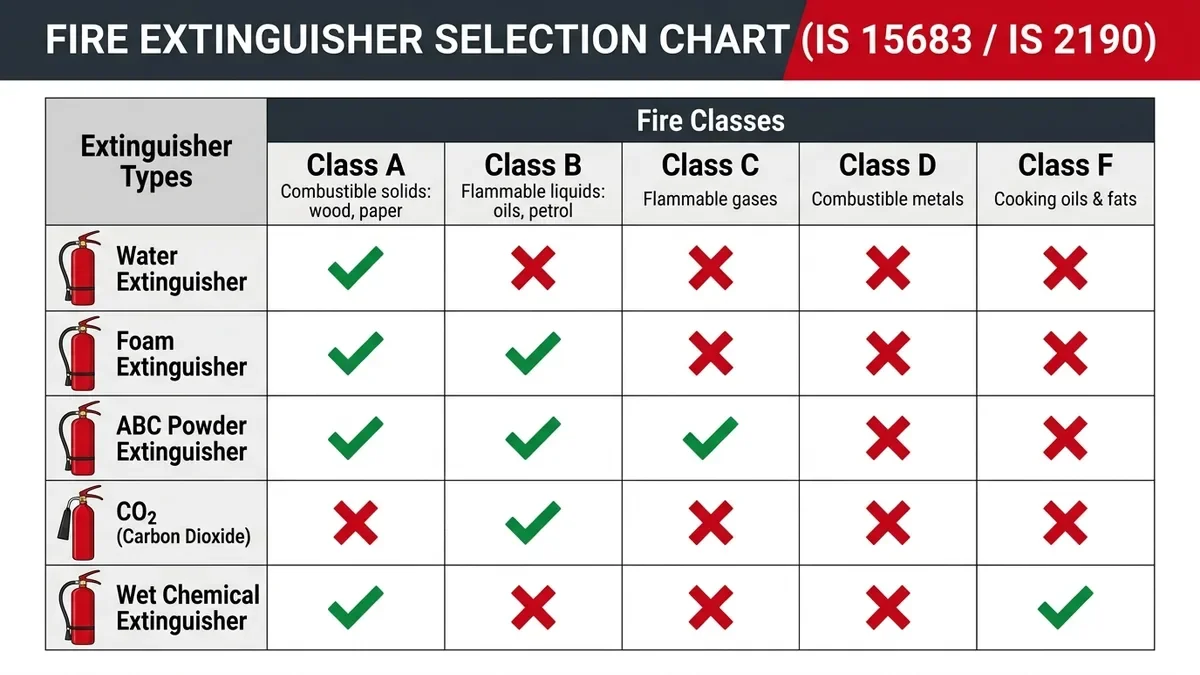
Matching the appropriate extinguisher to the risk profile of each room or industrial bay prevents catastrophic equipment damage and personal injury. The two reference tables below summarise extinguisher compatibility and Indian fire classes.
Table 1: Fire Extinguisher Types, Suitability, Hazard Warnings & Common Locations
| Extinguisher Type | Works on Which Class | NEVER Use On | Typical Deployment Locations |
|---|---|---|---|
| Water (Stored Pressure / Mist) | Class A | Live electrical equipment, Class B liquids, Class F cooking oils | Offices, libraries, schools, paper warehouses, textile godowns |
| Mechanical Foam (AFFF) | Class A, Class B | Live electrical panels, Class F cooking oils, flammable gases | Fuel storage depots, paint shops, automobile garages, loading bays |
| Dry Chemical Powder (ABC) | Class A, Class B, Class C, Energized Electrical | Class F deep fryers; avoid sensitive clean-room data servers (leaves abrasive residue) | Industrial workshops, multi-storey buildings, fuel pumps, manufacturing shopfloors |
| Carbon Dioxide (CO2) | Class B, Energized Electrical | Deep-seated Class A embers (re-ignites), Class D metals, unventilated confined spaces | Electrical switchgear rooms, server rooms, laboratories, generator cabins |
| Wet Chemical | Class F, Class A | Flammable gas jets (Class C), live electrical equipment | Commercial kitchens, hotel canteens, restaurant cooking ranges, domestic kitchens |
| Clean Agent | Class A, Class B, Class C, Energized Electrical | Class D combustible metals | Data centres, control rooms, telecommunications racks, museums, hospital diagnostic suites |
Table 2: Indian Classes of Fire (IS 15683 / IS 2190) & Recommended Extinguishing Agents
| Class of Fire | What Burns | Common Fuel Examples | Right Extinguisher |
|---|---|---|---|
| Class A | Solid organic combustibles | Wood, paper, packaging cartons, textiles, trash | Water, Foam (AFFF), ABC Dry Powder |
| Class B | Flammable liquids and liquefiable solids | Petrol, diesel, solvents, lubricating oil, thinners | Mechanical Foam, ABC/BC Dry Powder, CO2 |
| Class C | Flammable gases under pressure | LPG cylinders, CNG lines, methane, acetylene, propane | Dry Powder (ABC / BC); isolate gas supply first |
| Class D | Combustible reactive metals | Magnesium ribbons, titanium shavings, sodium, potassium | Specialized Class D Metal Powder (TEC / copper powder) |
| Class F | Cooking oils and fats in culinary appliances | Vegetable cooking oils, ghee, lard, butter in deep fryers | Wet Chemical Extinguisher |
| Electrical Risks* | Energized electrical apparatus | Motors, switchgear panels, computer racks, transformers | Carbon Dioxide (CO2), Clean Agent, ABC Dry Powder |
*Note on Electrical Fires: Under Indian Standards IS 15683:2018 and IS 2190:2024, electricity is an ignition hazard rather than a separate fire class; only use an extinguisher on live electrical equipment if its label says it is safe for electrical fires.
How to use a fire extinguisher (PASS)?
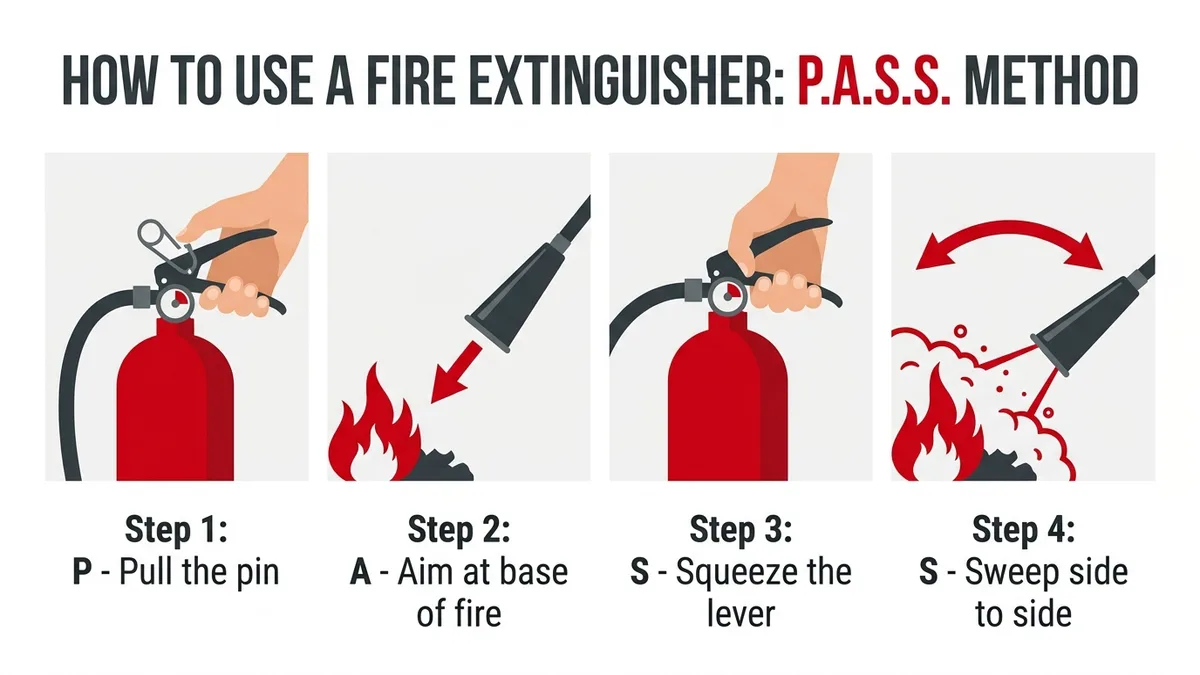
In an incipient fire emergency, speed and proper body positioning are critical. The globally recognised PASS technique guides correct execution in four distinct steps:
- P — Pull the Pin: Grasp the extinguisher firmly by the carrying handle (the lower lever). Pull out the metal safety pin located at the top of the valve body. This shears the plastic inspection tamper seal and unlocks the operating lever. Give the lever a momentary test squeeze to ensure the nozzle is clear before approaching the fire.
- A — Aim Low at the Base: Stand a few metres back, with your exit behind you. Aim the discharge nozzle or horn directly at the base of the fuel, where the burning material rests, rather than at the rising smoke or outer flame tips.
- S — Squeeze the Lever: Squeeze the top operating lever smoothly toward the carrying handle. This depresses the internal valve stem, releasing the pressurized extinguishing agent through the siphon tube and discharge hose. Releasing the lever halts the chemical discharge immediately.
- S — Sweep Side to Side: Move the discharge nozzle in a steady, deliberate side-to-side sweeping motion across the width of the fire base. Advance cautiously only as the flames subside. Once the fire appears suppressed, monitor the area continuously for flare-ups or smouldering embers.
What colours are fire extinguishers in India?
In India, extinguishers are red; check the label to know the type. Every extinguisher cylinder is painted red, and the printed instructional label on the body clearly indicates the extinguishing medium (Water, Mechanical Foam, ABC Powder, Carbon Dioxide, or Wet Chemical), the classes of fire it is rated to fight, and operating instructions.
How often should you check and refill fire extinguishers?
Regular maintenance ensures that portable extinguishers discharge reliably when an emergency occurs. Under Bureau of Indian Standards code of practice IS 2190:2024, check it regularly, get it serviced at least once a year by an approved fire service agency, and follow IS 2190:2024 for refilling and pressure testing.
- Regular Visual Inspection: Check the extinguisher regularly to verify that it is mounted in its assigned bracket, accessible without obstruction, the pressure gauge needle rests in the operable green zone, the safety pin and tamper seal are intact, and the cylinder shows no signs of damage or corrosion.
- Annual Servicing: Get it serviced at least once a year by an approved fire service agency to examine mechanical valves, discharge hoses, operating mechanisms, and overall cylinder condition.
- Immediate Recharging: Recharging is mandatory immediately after any discharge, even if only operated for a few seconds during a minor incident or training drill.
- Refilling and Pressure Testing: Follow IS 2190:2024 for refilling and pressure testing schedules to verify cylinder shell integrity and extinguishing agent freshness. Never delay periodic hydraulic testing or servicing recommended under the standard.
What are the common mistakes when using a fire extinguisher?
Even when firefighting equipment is immediately available, operator error during high-stress situations can worsen the fire. Avoid these six critical mistakes:
- Aiming at the flames instead of the base: Spraying extinguishing agent into rising smoke and flame tops allows the fuel beneath to continue vaporising and burning unabated. Always direct the agent at the burning fuel bed.
- Using water or foam on live electrical systems: Discharging conductive liquid agents onto energized switchboards or machinery creates an immediate shock hazard for the operator and can cause massive short-circuit explosions.
- Attacking grease fires with water: Throwing water onto burning cooking oil causes explosive superheated steam expansion, scattering boiling oil and igniting adjacent structures. Use wet chemical agents or a fire blanket.
- Holding the bare horn of a CO2 extinguisher: During discharge, the CO2 horn gets extremely cold and can cause frostbite. Always hold the designated insulated handle grip rather than the horn itself.
- Ignoring the escape route: Always fight an incipient fire with your back toward an unobstructed exit. Never allow the fire to establish itself between you and your evacuation route.
- Attempting to fight an overgrown blaze: Portable extinguishers are designed strictly for incipient (first-stage) fires smaller than a standard office wastebin. If the fire spreads beyond its initial fuel source, toxic smoke fills the space, or the extinguisher empties without knocking down the flames, evacuate immediately and dial 101 for the fire brigade.
Master Live Fire Drills & Emergency Protocols
Practical extinguisher handling, live drill yard simulations, and industrial hazard assessment are core hands-on components in the Certificate Course in Fire & Safety (CCFS) and the Diploma in Fire & Safety (DFS) at the National Institute of Fire and Safety (NIFS). Students gain structured practical experience under trained safety faculty across our training drill yards.
Companies Currently Hiring Through NIFS
NIFS/IFESM
SAFETY PROFESSIONAL
ROBOMATIC PRECON PVT LTD
SAFETY OFFICER
Beekay Steel Industries Ltd
Safety Officer
Frequently Asked Questions
Which fire extinguisher is used for electrical fires?
In India, Carbon Dioxide (CO2) and Dry Chemical Powder (ABC or BC) extinguishers are used for fires involving energized electrical equipment. CO2 is preferred for server rooms, computer systems, and electrical panels because it leaves no residue. Under Indian Standards, only use an extinguisher on live electrical equipment if its label says it is safe for electrical fires.
What is PASS in fire safety?
PASS is a 4-step technique for operating a portable fire extinguisher: Pull the safety pin to release the lock, Aim the nozzle low at the base of the fire, Squeeze the lever handle to discharge the extinguishing agent, and Sweep the nozzle from side to side across the base until the flames are fully extinguished.
Which extinguisher is best for home or kitchen?
For general domestic spaces, an ABC Dry Chemical Powder extinguisher provides versatile coverage for wood, paper, and electrical hazards. For domestic kitchens with cooking oils and frying pans, a Wet Chemical extinguisher or fire blanket is best, because water or standard powder can cause hot cooking oil to splash and spread the flames.
How often should fire extinguishers be checked and refilled?
Under Bureau of Indian Standards code IS 2190:2024, check it regularly, get it serviced at least once a year by an approved fire service agency, and follow IS 2190:2024 for refilling and pressure testing. Extinguishers must also be recharged immediately after any discharge.
Start Your Career in Industrial Safety Today
NSDC-approved Diploma, Advanced Diploma, and Degree programs with a dedicated placement cell.