Fire Safety Training in Visakhapatnam
If you've searched for fire safety training in Visakhapatnam, you've probably noticed most results look the same: a course list, a phone number, a "contact us" form. What's missing is the part that actually helps you decide — which course fits your background, what you'll be trained to do, and whether the city has enough real demand to build a career on. This guide covers all of it, using the same industrial landscape that makes Visakhapatnam one of the few Indian cities where fire and safety officers aren't optional hires.
Why Visakhapatnam Needs Trained Fire Safety Professionals
Visakhapatnam isn't a city that needs fire safety training in the abstract — it's built around industries where fire and process-safety risk is a daily operating reality, not a compliance checkbox.
The Visakhapatnam Steel Plant, run by Rashtriya Ispat Nigam Limited (RINL), produces around 7.3 million tonnes of liquid steel a year at its Gajuwaka works and employs close to 28,000 people directly — a single site large enough to run its own dedicated fire and safety department. A few kilometres away, the HPCL Visakhapatnam Refinery was the first oil refinery on India's east coast and remains one of Hindustan Petroleum's two refining sites, handling the kind of hydrocarbon processing where fire response has to be measured in seconds, not minutes.
The city's coastline adds two more employers most course pages never mention: the Visakhapatnam Port, one of India's major cargo ports, and Hindustan Shipyard Limited, alongside the Eastern Naval Command's dockyard operations — both environments with strict onboard and yard fire-safety protocols. On the pharmaceutical side, Jawaharlal Nehru Pharma City (JNPC) near Parawada is a dedicated pharma SEZ housing multiple manufacturing units, each required to run its own fire and hazard-control systems under factory law. The Greater Visakhapatnam Municipal Corporation's industries list confirms all of these as active sectors in the city.
Steel, petroleum, port logistics, shipbuilding, and pharmaceuticals — that's five active industrial sectors within a 40 km radius of the city centre. Under Section 40B of the Factories Act, 1948, any factory employing 1,000 or more workers is legally required to appoint a certified safety officer — a threshold RINL's Gajuwaka plant alone clears several times over. That's not a compliance formality; it's a standing, legally mandated hiring requirement, and it's the actual demand driving "fire safety training Visakhapatnam" as a search term.
What a Fire Safety Course in Visakhapatnam Actually Covers
Course pages tend to list a title and a duration and stop there. What you're actually being trained in, level by level, looks like this:
- Fire prevention fundamentals — fire chemistry, the classification of fires (A, B, C, D, and electrical), and why using the wrong extinguishing agent on the wrong fire class makes things worse instead of better.
- PPE and safety equipment handling — correct use, fit, and maintenance limits of protective gear, since expired or wrongly worn PPE is one of the most common causes of preventable injury on industrial sites.
- Firefighting equipment and systems — portable extinguishers, hydrant networks, sprinkler systems, and fixed suppression systems, including how to inspect them so they actually work when needed rather than just sit compliant on a checklist.
- Hazard identification and risk assessment — a structured way of walking a site and spotting fire and process hazards before they turn into incidents, rather than reacting after something goes wrong.
- Emergency response and evacuation planning — running drills, setting muster points, and coordinating with local fire services so an evacuation plan works under real pressure, not just on paper.
- Industrial safety management — machine safeguarding, hazardous-zone (HT/LT) electrical safety, and how to run a safety audit that a plant manager can actually act on.
- Regulatory compliance — Factories Act provisions, ISO 45001 principles, and the documentation trail regulators expect during an inspection.
Which of these gets emphasized — and how deep it goes — depends entirely on the course level. A Certificate course spends most of its time on the first three; an Advanced Diploma or B.Sc leans heavily into the last three, since those are the skills a supervisor or plant safety officer is actually judged on.
Course Levels, Duration, and Fees
Fire and safety training isn't one course — it's a ladder, and where you start depends on your current education and what role you're aiming for.
| Level | Example Course | Duration | Typical Entry Point |
|---|---|---|---|
| Certificate | Certificate Course in Fire & Safety (CCFS) | 3–6 months | 10th pass / 10+2 |
| Diploma | Diploma in Fire & Safety (DFS) | 1 year | 10+2 / ITI / any stream |
| Diploma | Diploma in Health, Safety & Environment (DHSE) | 1 year | 10+2 / ITI / any stream |
| Advanced Diploma | Advanced Diploma in Fire & Safety (ADFS) | 12 months | 10+2 / diploma holders |
| Advanced Diploma | Advanced Diploma in Industrial Safety (ADIS) | 12 months | 10+2 / diploma holders |
| PG Diploma | PG Diploma in Fire & Safety (PG DFS) | 1 year | Any graduate |
| PG Diploma | PG Diploma in Health, Safety & Environment (PG DHSE) | 1 year | Any graduate |
| B.Sc | B.Sc in Fire & Industrial Safety | 3 years | 10+2 / ITI / diploma |
| B.Sc (Hons) | B.Sc (Honours) in Fire & Industrial Safety | 4 years | 10+2 / ITI / diploma |
Fees vary by course level, mode of study (classroom vs. online), and whether the program includes practical training-yard access — so treat any flat number you see quoted online with some skepticism. The most reliable way to get an accurate figure for the course you actually want is to request a quote directly rather than relying on a generic city-page estimate.
Mode of study matters more than most listings admit. Online delivery works well for the theory-heavy parts of any course — regulations, documentation, risk-assessment frameworks — but the practical component (extinguisher handling, hydrant operation, live drill participation) is difficult to certify meaningfully without in-person training-yard time. If your target role involves hands-on plant-floor responsibility rather than a desk-based compliance function, ask specifically how much of the course is delivered on real equipment before enrolling.
Eligibility: Who Should Enroll in Which Course
- Fresh out of 10th or 12th, no work experience yet — start with the Certificate Course (CCFS) or a one-year Diploma (DFS/DHSE). Both are built for first-time entrants and get you job-ready faster than jumping straight to an advanced program.
- Already have a diploma or 10+2 with some technical background — the Advanced Diploma tier (ADFS or ADIS) is built for you, targeting supervisory and plant-floor safety roles rather than entry-level assistant positions.
- Any graduate looking to move into safety management — the PG Diploma tier (PG DFS or PG DHSE) is designed specifically for career-changers moving into HSE or fire-safety management roles.
- Planning a full degree-length career path — the 3-year B.Sc or 4-year B.Sc (Honours) in Fire & Industrial Safety builds toward senior safety officer, EHS consultant, and risk analyst roles from day one.
Placement and Career Opportunities
This is the one topic every competing page in Visakhapatnam mentions — because it's the actual reason people search for these courses. Graduates of fire and safety programs go on to roles including Fire Warden, Site Safety Officer, Industrial Safety Officer, Plant Safety Coordinator, HSE Manager, Fire & Safety Manager, and Risk Analyst, depending on the course level completed.
NIFS has a placement cell that supports graduates — a placement record that reflects the same real industrial demand covered above: steel, petroleum, ports, shipbuilding, and pharma manufacturing don't run without safety officers on payroll.
Why Train With NIFS in Visakhapatnam
NIFS is headquartered in Visakhapatnam itself — at Dwarakanagar, a short distance from the city's industrial corridor — with 15+ training centers across India built on the same course ladder described above. The institute is NSDC and Skill India approved, ISO 9001:2015 certified, and its degree programs run in academic affiliation with Acharya Nagarjuna University and Annamalai University, with SBTET, Andhra Pradesh recognition for its diploma-level courses.
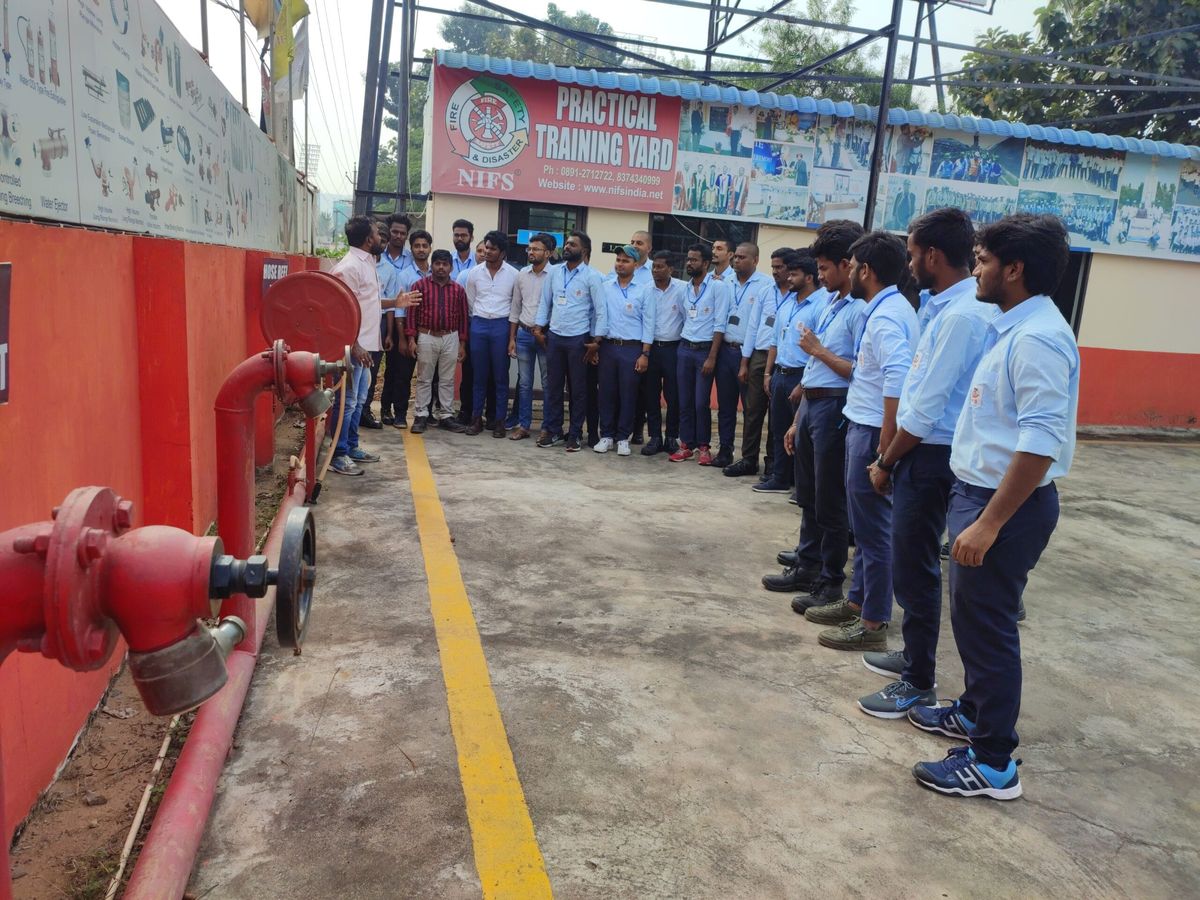
What's harder to get from a generic course listing is hands-on exposure, and that's where a dedicated practical training yard matters — live equipment, drill scenarios, and hazard simulations rather than classroom theory alone. If you're comparing institutes, ask specifically whether practical training happens on real equipment or only in a classroom; it's the single biggest quality difference between programs that look identical on paper. See NIFS's practical training yard in photos for what that actually looks like on the ground.
Frequently Asked Questions
Is fire safety training in Visakhapatnam recognized outside Andhra Pradesh?
Yes, when the course is run by an NSDC-approved and Skill India-recognized institute, the certification is valid nationally, not just within the state. Degree-level programs affiliated with a recognized university (such as Acharya Nagarjuna University) carry additional academic weight for government and PSU hiring.
Do I need a science background to enroll?
No. Entry-level courses like the Certificate Course in Fire & Safety accept students from any stream after 10th or 12th, since the curriculum is built from fundamentals — no prior technical education is assumed.
How long does it take to become job-ready?
A Certificate Course takes 3–6 months, and a one-year Diploma is enough for most entry-level Fire Warden or Site Safety Officer roles. Supervisory and management-track roles typically require the Advanced Diploma or PG Diploma tier.
Can I study fire safety training online while working?
Yes, most course levels are available in both classroom and online modes, though practical/hands-on components (equipment handling, drills) generally require some in-person time at a training yard.
Which industries in Visakhapatnam actually hire fire safety graduates?
Steel (Visakhapatnam Steel Plant / RINL), petroleum refining (HPCL Visakhapatnam Refinery), port and shipping operations (Visakhapatnam Port, Hindustan Shipyard Limited), and pharmaceutical manufacturing (Jawaharlal Nehru Pharma City) are the five largest local sectors with a standing need for certified fire and safety officers.
What's the difference between a Diploma and an Advanced Diploma in Fire & Safety?
The Diploma (DFS) is a one-year entry-level program aimed at supervisory-track roles. The Advanced Diploma (ADFS/ADIS) is also 12 months but assumes some existing technical background and is built for plant-floor safety leadership and industrial safety officer roles specifically.
Is placement assistance included after the course?
Institutes vary on this, so it's worth confirming before enrolling rather than after. NIFS has a placement cell that supports graduates — ask any institute you're evaluating for a similarly specific, verifiable placement track record rather than a general "100% placement" claim.
Choosing Your Course
Fire safety training in Visakhapatnam isn't a single decision — it's a ladder, and the right rung depends on your education level and how fast you need to be job-ready. NIFS's course catalog breaks down every level from Certificate through B.Sc (Honours) with eligibility and duration side by side. If you'd rather train close to home, see course fees, timings, and directions for NIFS's Visakhapatnam headquarters directly, or browse NIFS's other centers across India. When you're ready to move forward, apply through admissions to get an exact fee quote and enrollment timeline for the course that matches where you're starting from.
Have Questions About Admissions, Eligibility, or Fees?
Chat directly with NIFS Official Career Advisors on WhatsApp for free counseling and course guidance.
Chat on WhatsApp (+91-8374-340-999)Explore More
Companies Currently Hiring Through NIFS
NIFS/IFESM
SAFETY PROFESSIONAL
ROBOMATIC PRECON PVT LTD
SAFETY OFFICER
Beekay Steel Industries Ltd
Safety Officer
Frequently Asked Questions
Is fire safety training in Visakhapatnam recognized outside Andhra Pradesh?
Yes, when the course is run by an NSDC-approved and Skill India-recognized institute, the certification is valid nationally, not just within the state. Degree-level programs affiliated with a recognized university (such as Acharya Nagarjuna University) carry additional academic weight for government and PSU hiring.
Do I need a science background to enroll?
No. Entry-level courses like the Certificate Course in Fire & Safety accept students from any stream after 10th or 12th, since the curriculum is built from fundamentals — no prior technical education is assumed.
How long does it take to become job-ready?
A Certificate Course takes 3-6 months, and a one-year Diploma is enough for most entry-level Fire Warden or Site Safety Officer roles. Supervisory and management-track roles typically require the Advanced Diploma or PG Diploma tier.
Which industries in Visakhapatnam actually hire fire safety graduates?
Steel (Visakhapatnam Steel Plant / RINL), petroleum refining (HPCL Visakhapatnam Refinery), port and shipping operations (Visakhapatnam Port, Hindustan Shipyard Limited), and pharmaceutical manufacturing (Jawaharlal Nehru Pharma City) are the five largest local sectors with a standing need for certified fire and safety officers.
Is placement assistance included after the course?
Institutes vary on this, so it's worth confirming before enrolling rather than after. NIFS has a placement cell that supports graduates.
Start Your Career in Industrial Safety Today
NSDC-approved Diploma, Advanced Diploma, and Degree programs with a dedicated placement cell.