Safety Is Not an Expense. It Is the Cheapest Insurance.
Every factory owner keeps two account books. One sits on his table. The second is the hidden book that life maintains. In the first, safety shows up as an expense — a helmet at ₹300, a safety shoe at ₹800, two hours lost to training. In the second book, the absence of safety shows up as debt. When there is an accident, the debt collector comes — not in rupees, but in hospital bills, court cases, machine breakdown, worker fear, and sometimes a funeral.
As per data from the Directorate General Factory Advice Service and Labour Institutes (DGFASLI), a factory accident happens in India every 12 minutes — 80% of them in factories with fewer than 50 workers. The reason is simple: small factory owners assume safety is something only large companies like Tata or L&T need to worry about. The numbers below say otherwise.
The Real Cost of an Accident
Consider a real-world scenario from the Visakhapatnam Rural, Sri Laxmi Rice Mill belt: a small rice mill with 10 workers. A worker's hand goes into a belt with no guard. There is no death, but three fingers are cut. Here is what that single accident actually costs.
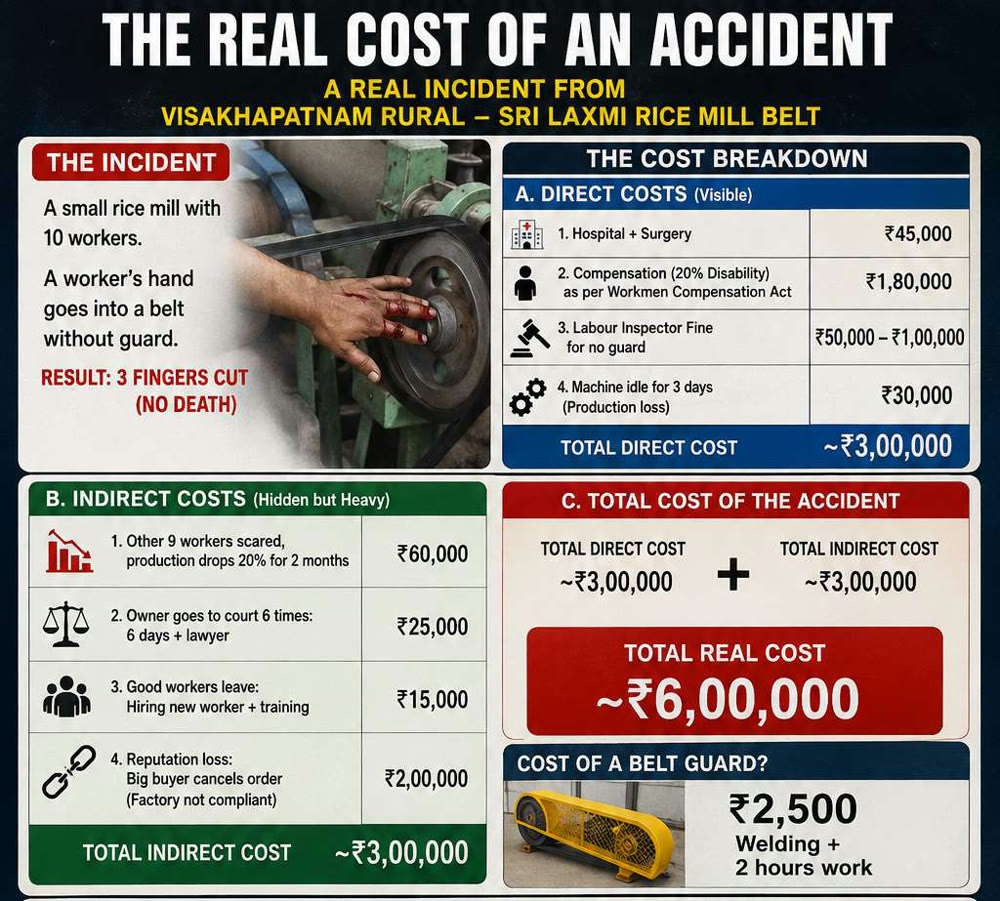
| Direct Costs (Visible) | Amount |
|---|---|
| Hospital + surgery | ₹45,000 |
| Compensation under the Workmen’s Compensation Act (20% disability) | ₹1,80,000 |
| Labour inspector fine for missing guard | ₹50,000 – ₹1,00,000 |
| Machine idle for 3 days | ₹30,000 |
| Indirect Costs (Hidden but Heavy) | Amount |
|---|---|
| Other 9 workers scared, production drops 20% for 2 months | ₹60,000 |
| Owner in court 6 times — 6 days plus lawyer | ₹25,000 |
| Good workers leave — hiring and retraining | ₹15,000 |
| Reputation loss — a large buyer cancels an order over non-compliance | ₹2,00,000 |
Total direct visible cost: roughly ₹3 lakh. Total real cost: roughly ₹6 lakh. A belt guard — welding plus two hours of work — costs about ₹2,500. The owner effectively paid ₹6,00,000 for not spending ₹2,500: roughly 240 times more. Safety is not an expense. It is insurance, and it is the cheapest insurance available.
Why Our Brain Tricks Us
Psychology explains why people underestimate safety risk even when the math is this one-sided.
- Optimism bias — “it happens to others, not to me.” Workers, supervisors, and managers all tend to believe accidents are less likely to happen to them than to someone else, which quietly lowers how seriously hazards get taken.
- Hyperbolic discounting — “save ₹2,500 today, worry about ₹6 lakh later.” The brain weighs an immediate cost more heavily than a larger future consequence, so safety spending keeps getting postponed.
- Normalization of deviance — “nothing happened last time.” A worker skips a helmet on day one and nothing happens. By day 100, skipping it feels normal. Day 101 is when a falling object causes a serious injury.
The 4 Types of Safety Insurance
Insurance is not one thing here — there are four layers, and most factories only ever invest in the last one.
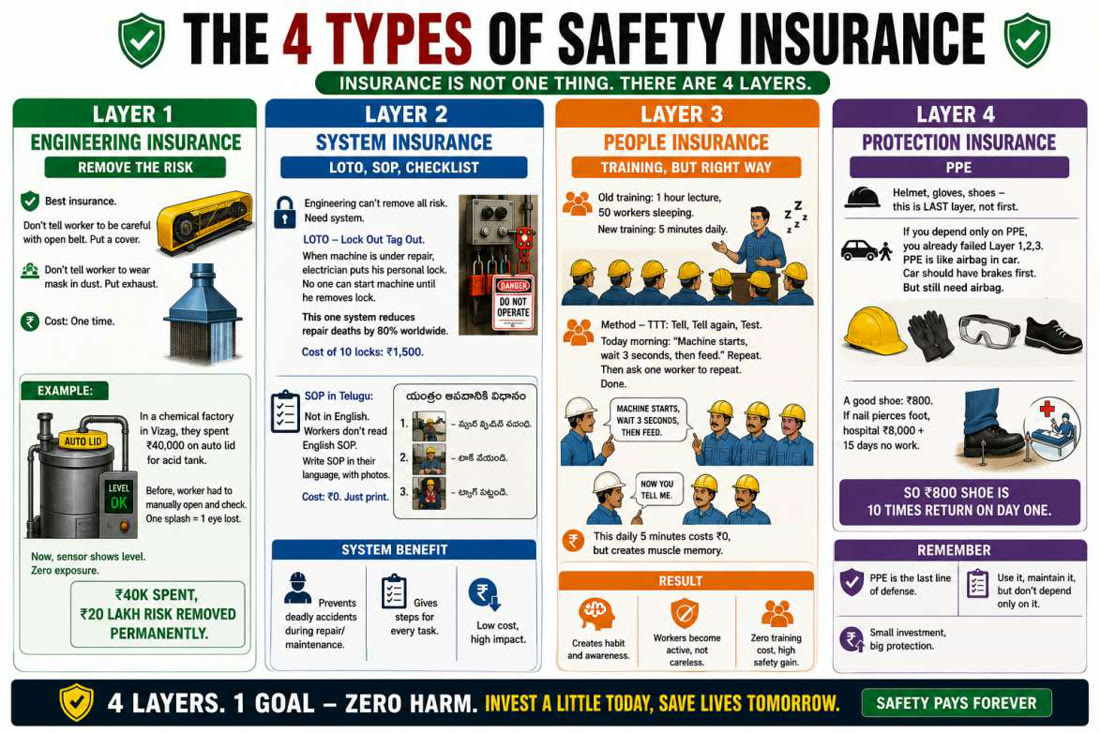
Layer 1 — Engineering insurance: remove the risk. The best insurance is a one-time fix. Don’t tell a worker to be careful around an open belt — put a cover on it. Don’t tell a worker to wear a mask in dust — install an exhaust. A chemical factory in Vizag spent ₹40,000 on an automatic lid and level sensor for an acid tank that previously required a worker to manually open and check it, where one splash meant a lost eye. That ₹40,000 permanently removed a risk worth roughly ₹20 lakh.
Layer 2 — System insurance: LOTO, SOPs, checklists. Engineering can’t remove every risk, so a system is needed on top of it. Lock Out Tag Out (LOTO) means the electrician repairing a machine puts their own personal lock on its power source — no one can restart it until they remove that lock themselves. This one system is credited with cutting repair-related deaths by around 80% worldwide, and ten locks cost about ₹1,500. Writing SOPs in the local language with photos, not in English, costs nothing beyond printing — and workers who don’t read English SOPs can now actually follow them.
Layer 3 — People insurance: training the right way. A one-hour lecture to fifty half-asleep workers teaches almost nothing. Five minutes daily, using a Tell-Tell-Test method — state the instruction, repeat it, then have one worker repeat it back — costs ₹0 and builds real muscle memory over time.
Layer 4 — Protection insurance: PPE. Helmets, gloves, and shoes are the last layer, not the first. Relying on PPE alone means Layers 1–3 have already failed — it's the airbag, not the brakes. Still, a ₹800 pair of safety shoes against an ₹8,000 hospital bill and 15 lost working days for a pierced foot is a ten-times return on day one.
How to Start With ₹10,000 — A 7-Day Action Plan
- Day 1: Walk the factory floor for 30 minutes and write down 10 real risks on paper — an open belt, missing earthing, oil on the floor.
- Day 2: Buy two fire extinguishers (₹3,000), a first aid box (₹800), and 20 helmets (₹6,000) — about ₹9,800 total, usually enough for a basic compliance inspection.
- Day 3: Fix three cheap engineering controls — cover belts, add earthing, clean oil spills. Roughly ₹2,000.
- Day 4: Buy LOTO locks, one per worker who does maintenance, each engraved or tagged with a name.
- Day 5: Write five SOPs in Telugu or the local language, with photos, and laminate them onto the machines they cover.
- Day 6: Start a 5-minute morning safety talk and appoint one senior worker as Safety Captain, with a small monthly allowance for the responsibility.
- Day 7: Take before-and-after photos of the factory floor and tell every worker: from today, anyone can stop a machine they believe is unsafe, with no salary cut for doing so.
Total cost: under ₹15,000. Return: the lifetime of the factory.
The Economics of Safety: Asset vs. Expense
When managers or accountants look at a budget, safety gear, training, and equipment modifications usually get filed under costs. That's a financial blind spot — safety behaves like a high-yield asset, not a recurring expense.
- Zero-maintenance loyalty: a physical machine guard never asks for a raise, a day off, or a salary. Once installed, it works around the clock without complaint.
- High ROI, low overhead: a 5-minute daily safety briefing costs almost nothing and never goes on strike, yet keeps safety top-of-mind for an entire shift.
- The true cost of an accident: before an accountant objects to a ₹2,500 safety item, it's worth pricing in the unlisted costs of a ₹6,00,000 accident — legal fees and regulatory fines, lost productivity and downtime, higher future insurance premiums, and damage to the company's reputation and ability to hire.
Conclusion — The Cheapest Insurance
Life insurance pays out after you die. Medical insurance pays out after you're hospitalized. Vehicle insurance pays out after the accident. Safety insurance is the only kind that prevents the accident in the first place.
A helmet never says thank you. A guard never asks for a salary. A 5-minute talk never goes on strike — but all three work every hour of every shift. The next time someone calls safety an expense, the right question is simple: if we don't spend on safety, how much will we pay for the accident instead?
“A safe factory is not a lucky factory. A safe factory is a smart factory.”
NIFS trains the safety officers and engineers who build exactly this kind of engineering-first, systems-driven safety culture on real factory floors — through programs like the Diploma in Industrial Safety and the Advanced Diploma in Industrial Safety (ADIS). For factories and industries looking to get a safety audit or compliance system in place, NIFS's industrial safety services team can help; students and parents evaluating a career in this field can start with admissions.
Companies Currently Hiring Through NIFS
NIFS/IFESM
SAFETY PROFESSIONAL
ROBOMATIC PRECON PVT LTD
SAFETY OFFICER
Beekay Steel Industries Ltd
Safety Officer
Frequently Asked Questions
Why do small factory owners see safety equipment as an expense instead of an investment?
Psychology plays a bigger role than budget. Optimism bias ("accidents happen to others"), hyperbolic discounting (an immediate ₹2,500 cost feels bigger than a future ₹6 lakh loss), and normalization of deviance (unsafe habits that haven't caused an accident yet start to feel "safe") all push owners to postpone basic safety spending until an incident forces the real cost into view.
What is the real cost of a workplace accident for a small factory?
Direct costs (hospital bills, statutory compensation, inspector fines, machine downtime) are only half the picture. Indirect costs — scared workers slowing production, court appearances, staff turnover, and cancelled orders from compliance-conscious buyers — typically double the total. A single avoidable accident can easily cost 200+ times more than the safety fix that would have prevented it.
What is LOTO (Lock Out Tag Out) and why does it matter for small factories?
LOTO is a system where the person repairing a machine puts their own personal lock on its power source, so no one else can restart it until they remove the lock themselves. It costs a few hundred rupees per lock but is credited with reducing maintenance and repair deaths by roughly 80% in industrial settings worldwide.
How much does it cost a small factory to start improving safety?
A basic 7-day starting plan — two fire extinguishers, a first aid box, helmets, covering exposed belts, earthing, LOTO locks, and local-language SOPs — costs under ₹15,000 in total and is usually enough to pass a basic compliance inspection while removing the highest-risk hazards on the floor.
Start Your Career in Industrial Safety Today
NSDC-approved Diploma, Advanced Diploma, and Degree programs with a dedicated placement cell.